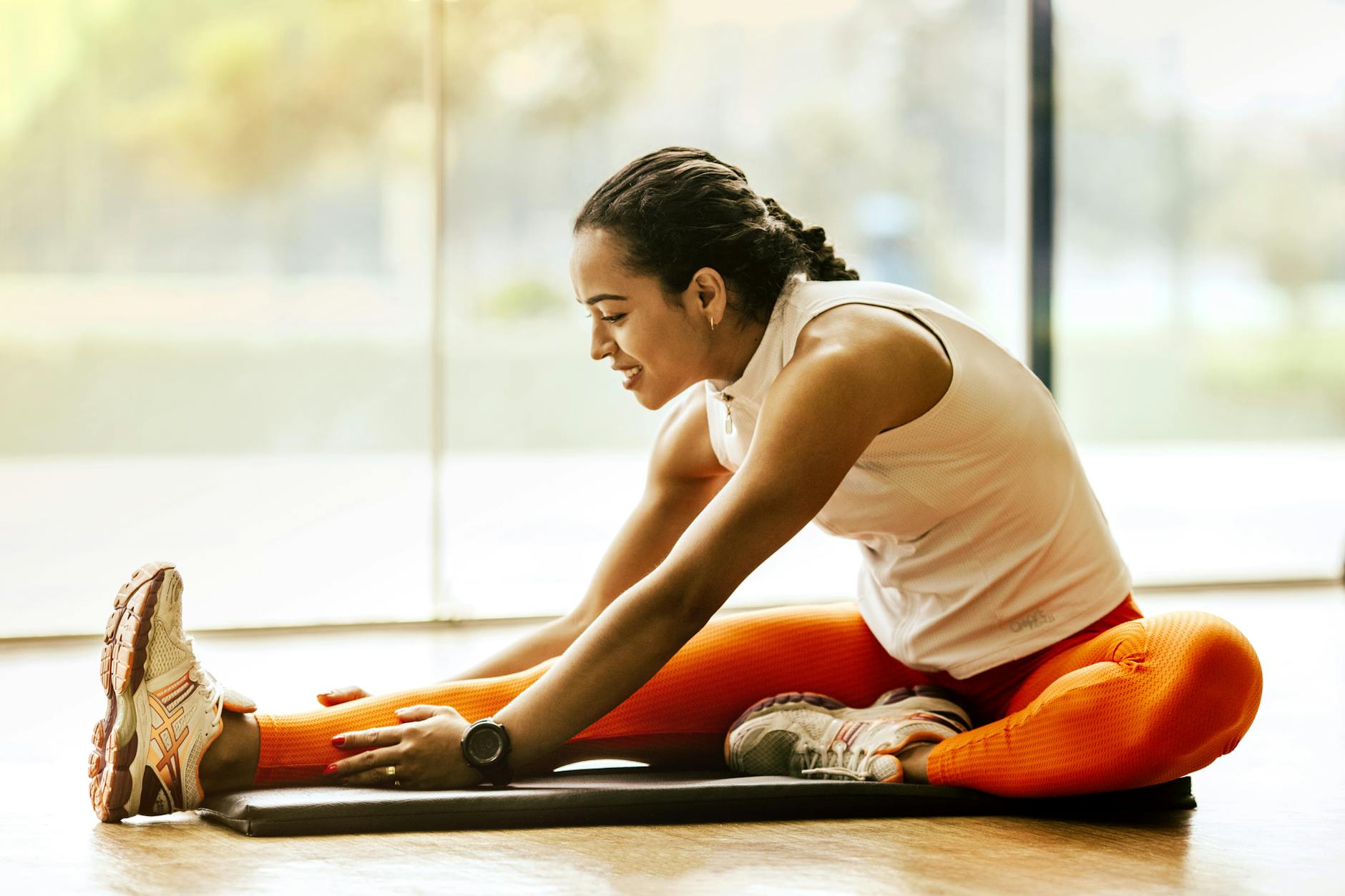
Do you sit up in bed in the morning and raise your arms over your head for that first stretch of the day? It’s instinctual, and there’s actually a term for it: Pandiculation. Humans, along with all vertebrate animals, tend to automatically pandiculate when we wake up or when we’ve been stationary for a while. If you’ve ever seen a cat arch their back when they get up from a nap, you’ve witnessed the pandicular response. When we pandiculate, we’re contracting muscles that have been inactive. Pandiculation is an automatic response that prepares out bodies for movement.
So, in a way, we are wired to stretch.
We’ve all heard about stretching and how important it is. But do we know why? What is actually happening when we stretch?
Stretching causes our muscles to be lengthened. Yes, it’s that simple. Stretching is regulated by the “stretch reflex”. When a muscle is lengthened, it wants to contract again. Think of an elastic band, and how once you’ve pulled it tight, it’s working to go back to it’s original position. Stretching causes your stretch reflex to subside. Your muscle then begins to adapt to a new length without aggressively firing the contract reflex. So by gently, and consistently, stretching your muscles, you’re signaling to your body and your brain that this new lengthened version is “normal.” And this new normal allows you to move throughout larger ranges of motion for day to day life with reduced injury risk.
And there are numerous other benefits to a consistent stretching routine:
Improved Flexibility: Your muscles will have a full range of motion so you can continue doing all of the activities you need and love in your daily routine and it will be easier to incorporate new movements and activities into your life
Improved Balance: You will be at a lower risk of falls and able to perform more complex moves both when exercising, and in real life situations like trying to reach something on a high shelf, or being able to do that yoga pose without falling
Improved Mobility: You will continue to be able to function in the manner you want throughout your entire life, continuing with all your favorite activities
Independence: You won’t be reliant on canes, walkers, or other people as you age
Reduced pain: You’ll be able to move as you want, without feeling it in your back and joints. Strengthening muscles and joints can also reduce back and knee pain caused from arthritis
Preparation for more physical activities: You’ll be better prepared to take on a new activity like running, where a sprinter needs to be able to fully extend and rotate their hips in order to achieve maximum speed
Releases endorphins: Those feel-good hormones can act as a pain reliever and also cause feelings of euphoria
Improves circulation: Stretching helps with circulation by increasing blood flow to the stretched area, widening the blood vessels to allow more blood to flow through. The increase in blood flow means your muscles are getting more oxygen, and are getting rid of more waste products
Stress reduction: Stretching will lead to stimulation of your parasympathetic nervous system which is responsible for rest and digestion, as well as inducing feelings of calmness and relaxation
Better posture: Muscle tightness and tension can negatively impact your posture by putting your spine into positions that can put stress on your back, neck, and core
Reduced risk of injury: Stretched muscles can help reduce injuries by improving blood flow, flexibility, and range of motion
The benefits of stretching are something you might not notice immediately, but over time you will be reaping all of the benefits as well as improving your quality of life in later years. Of course, the opposite is true. You might not be noticing any negative effects of NOT stretching–until its too late.
There are 2 different types of stretching, each accomplishing a different objective.
Static Stretching is when you hold a single position for a period of time. It requires moving a muscle as far as it can go but not so far as to be painful, holding the stretch for 20 to 45 seconds and if desired, repeating 2-3 times. No bouncing. Static stretching is best used as part of your cool-down routine following a weight or cardio workout, when your muscles are warm, to assist in reducing risk of injury and soreness. Use it also alone as a maintenance program to take advantage of all the benefits of stretching.
Dynamic stretching is a controlled movement that prepares your muscles for performance and safety. During a dynamic stretch your body is in continuous movement, as opposed to holding a single position. As with static stretches, you can limit dynamic stretches to the body parts you plan to work on that day. Dynamic stretches prepare your body for a workout by increasing blood flow to the specific muscles and preparing your body for the workout movements by going through a series of movements. Dynamic stretching has been shown to improve performance during your workout, and therefore is most effective when used after a warmup and before a scheduled workout. In some cases–such as jumping jacks–your dynamic stretch can do double duty as your warmup. Gently warming up your muscles in this way could also make your workout more effective. A typical dynamic stretching series focused on 2 or 3 muscle groups may last as little as 3-4 minutes.
Both types of stretching are most effective when muscles are warmed up, which improves mobility, blood flow, and reduces stiffness and risk of injury. And stretching can be done outside of a workout as well. It doesn’t require much time, or space, and needs no equipment. There are many stretches you can do while sitting at your desk or in front of the tv. Even standing in line or sitting in your car (but keep your hands on the wheel and your eyes on the road!) And as with your regular workout, be conscious of your breathing so you aren’t holding your breath.
There are an unlimited number of stretches that you can do, but below are some common ones that you can try to get started. If you’re already on a schedule with a workout routine, I recommend incorporating muscle specific stretches before (dynamic) and after (static) your workouts. Then try adding in a full body static stretch workout on your rest days. If you’re not currently engaging in a regular cardio or strength routine, you should still be stretching, so choose some stretches from the list below to get started.
Static stretches: Hold each stretch for 30 seconds before switching sides, if applicable.
Neck stretch: This is a stretch you can do anywhere: Sitting, standing, even lying down. Simply tilt your head to the left, with your head still facing forward, until you feel a stretch. You can use your left hand to gently press your head to one side for a deeper stretch but no jerky movements and don’t press too hard. Keep your shoulders pressed down.
Chest Stretch: Stand up straight with your body aligned in a straight line. Interlock your fingers behind your back and gently pull open your chest, keeping your back straight and your shoulders down and squeezed toward each other. For a deeper stretch, you can gently pull your arms up behind you.
Shoulder Stretch: While standing or sitting, hold one arm straight out in front of you. Gently use the other arm to pull the arm across your body until you feel the stretch in your shoulder. Some people will hook the arm with their elbow (see illustration below).

Triceps Stretch: In a standing position, raise both arms up straight. Then bend your left arm with your hand reaching behind your head, until you feel a slight stretch in your triceps. Place your right hand on your left elbow and gently push the elbow to get a greater stretch.
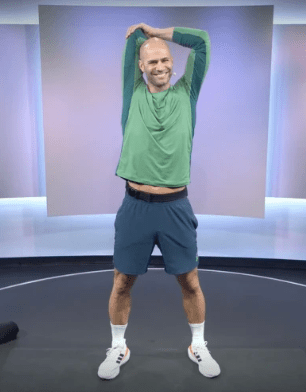
Biceps Stretch: In a standing position, raise your left arm out in front of you with your palm facing up. Use your right hand to gently pull your fingers down until you feel the stretch in your biceps.
Side Stretch: Stand tall and place your hands on your hips. Bend at your waist to the left until you feel the stretch. Be sure to continue facing forward and not twist your hips. Alternately, you can stretch your right hand over your head toward the left for a deeper stretch.
Abdominal Stretch: Lay flat on the floor on your stomach. Placing your hands flat at your sides, push your upper body away from the floor until you feel the stretch in your abdominals.

Hip Flexor Stretch: Sit on the floor with your legs in front of you. Bend your left leg at a 90 degree angle and move your right leg behind you in a bent position. Gently lean forward until you feel the stretch.
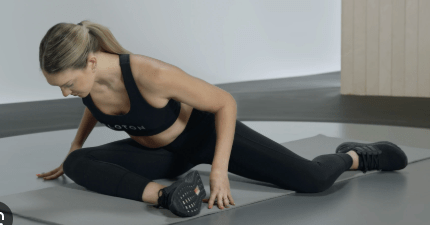
Hamstrings Stretch: Sit on the floor with your legs together and straight out in front of you. Gently lean forward until you feel the stretch in your hamstrings. If you can, you can hold place your hands under your knees or shins, or when you’re more flexible, hold onto your feet.
Quadriceps Stretch: Lie on the floor on your left side. Bend your right leg back so your foot is moving toward your bum. Reach back with your right hand and grasp your leg at the ankle or shin. Gently pull the foot toward your bum.

Calf Stretch: Stand facing a wall with your palms against the wall and your feet about 6 inches away from the wall. Step your left foot back, keeping your heel on the floor, so your left foot is straight and you right leg is bent, feeling the stretch in your left calf.
Dynamic Stretches:
Arm Circles (Works shoulders, neck, and upper back, and even a little chest, biceps and triceps): Stand straight and bring each arm straight out to the side. Rotate each arm in slow circles toward the front for 20 rotations and then reverse and rotate toward the back for 20 rotations.

Leg swings (works glutes, hip flexors, and hamstrings): Stand straight. Gently swing your left leg forward and backward for 20 repetitions. The swing the leg from side to side for another 20 repetitions.
Jumping Jacks (works shoulders, inner and outer thighs, calves and glutes): Stand straight with arms at sides. Simultaneously move your arms up and toward you head while jumping your legs apart, to form an “X.” Repeat 20 times.
Inchworm (works hamstrings, core, shoulders and chest): Stand straight with feet hip width apart and arms at sides. Slowly bend over and touch hands to floor, keeping legs as straight as possible. Walk hands forward until you reach a plank position. Reverse to starting. Repeat 20 times.

 F Words that are not 4 Letters