I am a writer, banker, and mother from Boston, Massachusetts. I am passionate about all these roles and feel I've learned a thing or two about Family, Friends, Fitness, and Finances. And, of course, I still have a lot to learn! I hope you enjoy my thoughts and I look forward to hearing yours.
One Sentence Summary: A young couple with a troubled marriage travel to a secluded location for a weekend and get caught up in mystery and deceit
Best Thing About the Book: Suspense builds within the first pages as each narrator confesses to having secrets and motives for their weekend away
Worst Thing About the Book: Because the full plot line takes place over the course of a weekend, there is a lot of back and forth with the past, and every action that takes place in the house is shrouded in mystery so its almost too much to keep track of, especially if you’re someone who likes to try to guess at what’s going on
Did it Make Me Want to Keep Reading: Yes, she always creates an atmosphere where you have to know what happens
What I learned: One of the main characters suffers from an actual disorder called prosopagnosia, otherwise known as face blindness that makes it hard for the individual to recognize faces and can even cause them to have trouble recognizing the people in their own lives
The Bottom Line: Having read this author before, I knew there would be a juicy surprise ending, and although I still did not see what was coming, after I knew the twist, it seemed very reminiscent to me of her prior books
Would I Read this Author Again: Yes, I think only have one left to go (see below); His & Hers is still my favorite
Next Book to be Read By This Author: Daisy Darker, which I don’t think is out quite yet
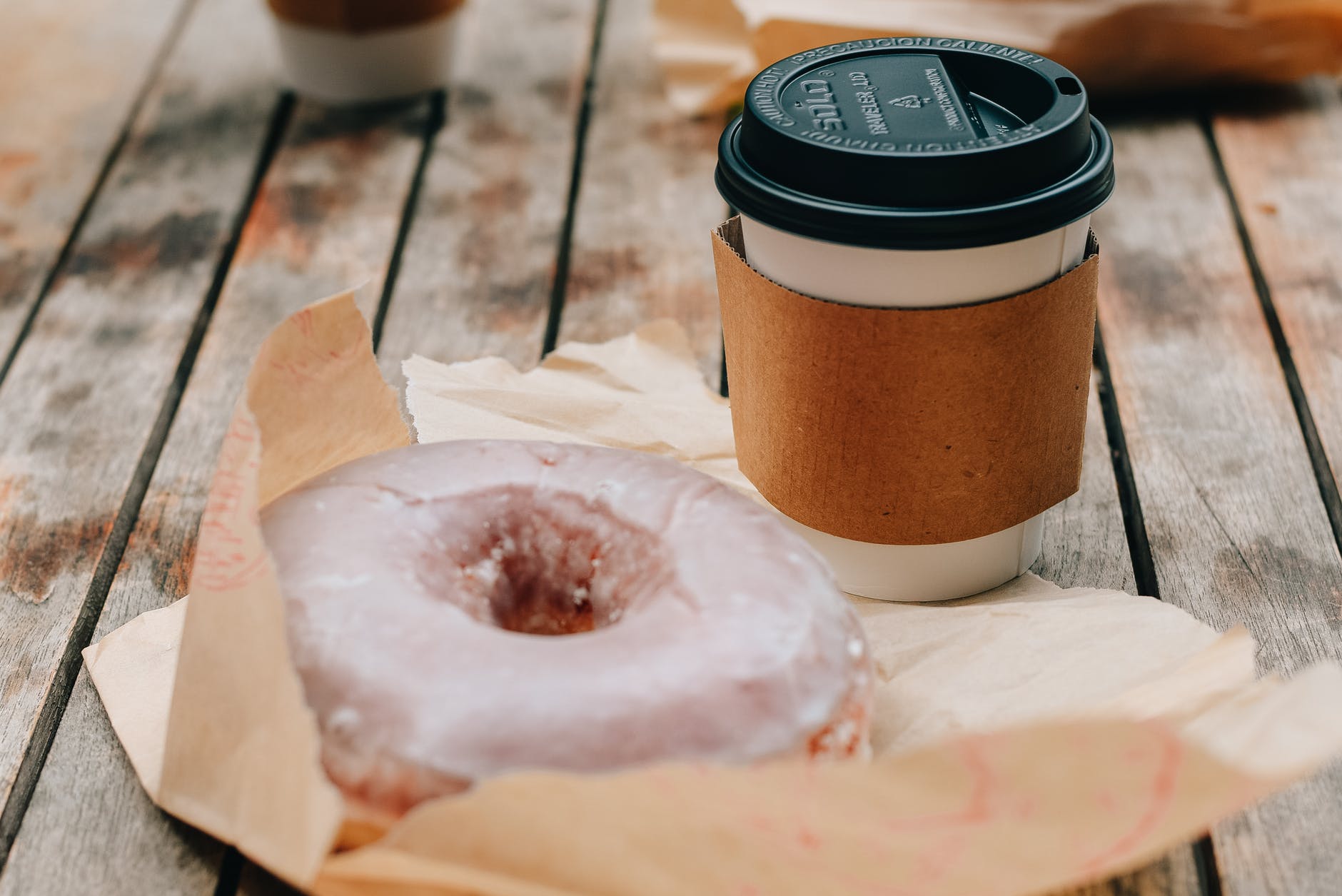
I remember when I was a kid, and the first Dunkin Donuts opened up in our neighborhood. Im guessing it was the late 70s. We did not have a car, and it opened right at the end of my short street, intersecting with a busier street in the City. In other words, within walking distance from my house. There wasn’t a lot of money for extras like donuts, so it was a truly special occasion when my mother would walk us up the street and treat us to a dozen donuts. The employee would pull out the flat, cardboard box and quickly and expertly assemble it by folding up the sides and sliding the tabs into the slots. Most of the time we were not paying attention to this phase of the adventure, as our eyes were scanning the five levels of fresh donuts from which we would choose our favorites. Sure, you could ask for all 12 donuts to be the same type, maybe chocolate or honey dipped. Or you could just ask for “assorted,” in which case the Dunkin employee would select the different varieties. But in order to make sure you got your favorite, you had to call out each donut variety one by one, and this is typically what we did.
Back then, of course, I was too young for coffee, and my mom was never much of a coffee drinker, so we would leave after our critical selections and make the short walk back home, carrying our treasure, and once back at the house we would ravenously dig into the box and extract a truly special treat. It’s a great childhood memory.
These days, most people go to Dunkin for a coffee. They’ve even dropped the “Donuts” from their official name and as of 2018 are now just “Dunkin.” A shift has taken place in both culture, and business strategy. According to an article in Fortune in 2017, the name change, and refocus is due to a healthier lifestyle amount consumers. While breakfast may be the most important meal of the day, the combination of carbs and sugar contained in a donut aren’t really the metabolic medicine that the doctor ordered.
But is there another motive in the shift? In Spain the franchise is already called Dunkin’ Coffee; Do the coffee products offer more options? All of us work with at least one coworker whose coffee order is 7 or 8 words long. Dunkin reported that there were over 15,000 different ways to order their coffee. Donuts, on the other hand are not as popular. These days, there are only around 20 varieties of donuts with some seasonal offerings. Dunkin sells more coffee than donuts, and while donuts aren’t growing, coffee still is. Perhaps most importantly, coffee is more profitable than donuts. As recently as the 80s, it wasn’t unusual to pay 50 cents for a cup of coffee. I can hear you laughing. A basic “regular” coffee is now about $3 and a Coolatta costs $4.99. You don’t want to do the math on how much you’re spending annually for that daily indulgence.
Other donut retailers may have failed to make the change in focus quickly enough.
Krispy Kreme has been making donuts for 80 years, since 1937. The 2 local stores in Dedham, MA and Cranston, RI (the last 2 from an original 8 stores in NE)closed in 2007, eliminating Krispy Kreme’s presence in the Northeast.
According to a 2021 article in mashed.com “In September 2018, Dunkin’ announced that it was dropping the Donuts from its name. The move represented a long-recognized reality — that Dunkin’ primarily operates as a beverage company that sells donuts, not as a donut company that includes coffees as a side. Reporting on the name change, NPR noted the percentage of sales beverages represented increased between 2013 and 2014 from 58 percent to 60 percent. Even in 2013, Dunkin’ Donuts CFO Paul Carbone, according to Forbes, told investors, “We are a beverage company.” “
The verdict is in on the change in strategy, reflected in the success Dunkin’ found in the last financial quarter of 2019, where, according to The Motley Fool, it had its largest growth period in six years. Dunkin’ credited its booming business to its new beverage offerings, not the donuts that built its base.
Hey, I like a good cup of coffee as much as the next guy. While I don’t typically indulge in the more fancy flavors, I rely on my morning cup of joe to help kickstart my day. I sometimes meet friends for coffee and it’s frequently an important part of morning business meetings. But I still long for the days of a family walking to the local coffee shop and picking out a special treat to be enjoyed around the breakfast table. A simple treat for a simpler time.
Have I read this Author Before: Yes; the Alphabet Series A-J
One sentence Summary: Private Investigator Kinsey Millhone is hired by the mother of a girl who died about a year before and whose badly decomposed body was ruled an accidental death but her mother suspects murder.
Best Thing about the Book: The series is an entertaining, easy read; While the lead character, Kinsey is somewhat predictable after reading A -J in the series, we always learn something new about her character and I like the references back to incidents that happened in prior books.
Worst Thing about the Book: I’m never able to solve the mystery, but usually it’s because critical pieces of information are withheld until the end.
Did it Make me Want to Keep Reading: Yes, Grafton writes well and offers characters with a lot of physical description. These books are an quick read and you will want to keep going until you know the resolution.
What I Learned: Some of the details of what happens at a water treatment plant.
The Bottom Line: This series is entertaining, and I always look forward to the next mystery.
Would I read this Author Again: Yes
Next Book to Read by This Author: L is for Lawless (of course)
Recently, while driving, I noticed a new building going up just around the corner from my house. Hmmm, I thought: New restaurant? Liquor store? Obviously my thoughts drifted to the products that I would enjoy the most from a new neighbor. But closer scrutiny illuminated something else. A storage facility. I inwardly groaned. Not only did this not benefit me in any way, but it is also unattractive, and a reminder of the excesses we seem to maintain. We need more space to keep more stuff.
Yes, we Americans have a hard time parting with our stuff. It might be the fear that immediately after parting with an item we will have a desperate need for it. Or maybe guilt, because it was a special gift from someone we love. Or an item that holds a special memory from a departed loved one. I’m not talking about hoarding, which is a mental illness, and may lead to a clutter situation that can make a home unliveable. What effects more of us is just the compilation of extra things over a period of time. Things that clog our basements, attics, and closets.
I admit, I’m guilty too. I have a closet full of clothes, only about half of which I wear regularly. And shoes, well, let’s not go there. I have a basement full of things I might need someday, and 3 crates of Christmas decorations, even though I only pull out about a third of them as each December rolls around.
I’ve been making an effort to downsize my stuff. Facebook Marketplace, Salvation Army, trash, are all good ways to eliminate unneeded items. Lots of things like new, but that I know I will never use again. For me it is satisfying to remove clutter from the house. To take a walk into a room and see clean, empty space where there once was a pile of unused items.
I’ve tried to make a dent in new items coming into the house as well. Do I need a new air fryer, or popcorn maker? I’ve certainly survived this long without either. And at Christmas, the focus has been much more on experiences than objects. This past year, gifts included tickets for musicals for my mother and daughter, an experience for driving a race car for my son, and an airplane flying lesson for my boyfriend. All, I hope, will exist in their memories long after the new sweater, perfume, or tech gadget will.
If you need evidence that our current society owns too many “things,” look no further than the nearest storage facility. While I admit to extra clutter in my house, I have to wonder at who is filling their home with things and then still needs a storage unit for other stuff? What are they putting in there?
Here are some staggering statistics:
65% of storage facility renters have a garage, 47% have an attic, 33% have a basement
The storage business costs us 38 billion dollars annually
Between 2015 and 2020, the number of storage facilities in the US increased 584%
Some usage makes sense: Businesses storing excess inventory, millennials moving into crowded, small, downtown spaces; Baby boomers downsizing after 40 years of collecting stuff. And then there’s just that discretionary income with which we want to have the newest gadget, appliance, or piece of furniture. While these reasons seem legitimate at first, a storage unit is “out of sight, out of mind.” Many people put things there as a temporary solution, and then largely forget about them. A year will pass and not only have they not had the need for any of those items, but they’ve also been paying a monthly fee for 12 months, perhaps unnecessarily. A better option might be to get rid of those items. And while we’re at it, get rid of that other “stuff” we’re not using in our homes.
Professional organizers can rattle off the benefits of decluttering.
If you’re paying for a storage facility, you’ll be saving money
Easily find what you’re looking for, resulting in less stress and time savings
Feeling in control, resulting in pride and self-esteem
Better relationships, if others in your home like things neat and tidy; also you will likely socialize more if you are comfortable inviting your friends over and also don’t have to fear unexpected drop-ins
Better health as decluttering leads to cleanliness, less dust, mold, mildew; a clutter free kitchen will lead to more food prep at home, which is often healthier, and studies show that people sleep better in a neat room with a tidy bed
That all sounds great, so how to get started? If you’ve been gathering and saving for many years, the task can feel overwhelming. The key is to start small. Really small. Start with a single drawer, or cabinet. I recently scheduled myself to clear out my “tool bin.” This is a large plastic container in my basement where I toss my hammer, nails, screwdrivers and other home repair items. As I sifted through I discovered many unnecessary items (How many screws do I actually need??), some repetitive items, and some items that I might need someday, but that are easy, and inexpensive to obtain, thus eliminating the need to keep one on hand. The result was a reduction of my bin by about half. I moved my items to a smaller bin, thereby freeing up some more free space in the basement. And yes, it felt good. So I’ll keep working at it. I’ve already scheduled my next little project for this coming weekend and while it’s still a little difficult to part with some things, I’m looking forward to the sense of accomplishment, and the look of that newly clean space.
I’ve been practicing good physical fitness for about 30 years. That sounds like a long time, but I actually didn’t start to think about my health in this way until after I was married. I was relatively active as a youngster. I grew up next to a school and so had easy access to an area well suited for sports. Basketball, wiffle ball and kickball were daily occurrences while the weather cooperated.
But I didn’t really think about what was healthy, and as I entered my teen years, and socializing became a bigger part of my life, there were fewer basketball games and more card games, and I started to gain weight. I could sense my endurance diminishing in the rarer cases that I found myself needing to run, or participate in something active.
When I finally started to take my health more seriously, I had a lot of starts and stops. I did some research, set up a small gym for myself in the basement, and began teaching myself how to work out. It wasn’t easy. I know I slipped many times, telling myself I was too tired, or too busy. But I started to get into a routine. It was easier for me to work out in the evenings, so I got right to it when I got home at the end of my workday. I alternated cardio (back then we called it aerobics) workouts with strength training, spending 30-45 minutes a day. I started to see results. And I liked it. My arms were more defined, and I had abs! I slowly lost some weight and I felt great. I became addicted to the way I looked and felt.
My workouts have changed frequently over the years, sometimes more intense, sometimes less. Sometimes a greater focus on cardio, sometimes strength training, but I have always maintained a schedule and a routine. I might take a week off during the busy holiday season or when things are crazy at work, and I have changed my workouts to mornings now, but staying physically active is still a big, consistent part of my life.
One thing I’m certain of: It is much easier to stay in shape, than to get out of shape and have to get back in shape. So I frequently wonder, would things have been easier if I had started my journey to physical fitness earlier, as a child? And would the benefits have been greater?
Many of the ailments that plague adults, such as diabetes, high blood pressure, and obesity, have their roots in early childhood. By starting an exercise routine early, these maladies can often be avoided. So it seems to make sense that teaching kids about physical fitness at an early age is a great idea.
Children are the recipients of the same physical benefits as adults when it comes to both cardio and strength training exercise:
Increased strength and endurance
Increased flexibility
Improved posture
Increase metabolism
Enhanced motor skills
In addition, there are numerous non-physical benefits that can be particularly helpful to children:
Psychological well-being
Improved sleep
Setting, and working toward goals
Improved self-esteem
So how can you, as a parent, get your kids on the right path? Kids naturally love to move and play, so encourage this whenever possible. If their screen time seems to be higher than usual on a particular day, head outside for a game of tag or hide and seek. If the weather is preventing you from going outside and you’re looking for some indoor inspiration, check out kids workouts on YouTube. With your smart tv you can display the workout on a big screen and the kids will feel like they’re attending a fun class. Here are some more suggestions to help you get started and stay on track.
Make physical activity part of your daily routine, from the time kids can walk
Engage in lots of active play time both indoors and outdoors
Try lots of new activities and make it fun
Let them know about the benefits of staying active and how they’re keeping their bodies healthy
Make it part of a daily routine much like eating, brushing teeth, and sleeping
Exercise with them and emphasize benefits like improved strength and endurance
As they get older, you can make physical activity more structured: Okay we’re going to work out now so our bodies stay strong and healthy! Kids as young as 6 or 7 can understand a routine and also benefit from more structured routines, like strength training. If you’re not sure how to start with something like this, find an online resource to be sure you’re doing it safely. In particular always:
Consult with a doctor before beginning a strength training routine, especially if any medical conditions exist
Warm up and stretch before exercising
Use proper form
Stay hydrated
Be sure to take days off between strength training workouts
Don’t forget to breathe!
No matter the age of your kids, you can still institute some healthier habits. If they’re a little older you may need to start slowly with small changes, or exploit an activity you know they already enjoy by offering to take them to the skate park or basketball court. Like most behaviors, a good role model is the best teacher, so let them see you being active and exercising even on days when you can’t convince them to join you. By building these good habits early, you’re helping them to be healthy and preventing undesired medical conditions like obesity, diabetes and high blood pressure. In addition you will likely see their confidence and self-esteem improve as they see the benefits of regular exercise. So what are you waiting for? Go grab your kids and get active!
In Massachusetts, when we say “North Shore, ” we’re talking about locations on the coastline, North of Boston. The South Shore is locales South of Boston. While I live relatively close to the South Shore, I have not spent a lot of time exploring that area, so I chose a cold day in January to accomplish that objective.
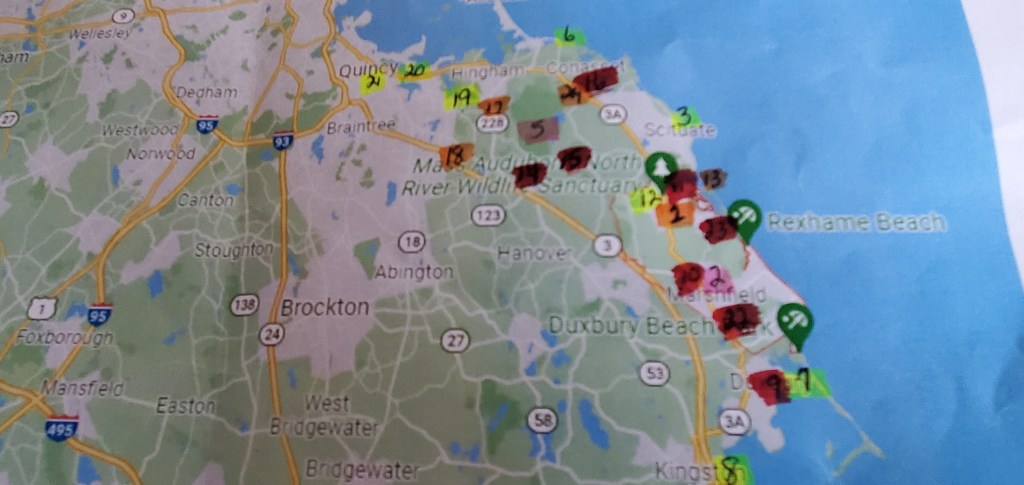
I spent a couple of days in my typical research, creating the map shown above. This helps me to know which direction to head and in which order to visit my destinations while minimizing travel time and backtracking. The numbers correspond to a list not pictured here, with detail about what the item is, and the colors reflect a coding system. Red = eating locations, pink= hiking, etc.
When putting this day together, I expected Jay, my most frequent travelling companion, to be joining me, but when he was unavailable at the last minute, I put a text out to my Tribe of 6 friends to see if anyone had interest in my little adventure. Jeanne responded that she was available, so at about 9:30 on that Sunday morning, we departed in my car equipped with plenty of warm weather gear, snacks, and my map. Although very cold, we had a sunny, mostly wind free day.
While I usually like to start my day trips with a hike, we decided to forego that particular activity on this day, as the temperature at 9:30 in the morning was still in the single digits. We were heading from South to North, with our first stop being Gray’s Beach in Kingston. A beach on a New England January day you might ask? Yes! This turned out to be a nice surprise. A very clean beach with plenty of parking and just a few steps to get to the sand. Also gorgeous views. There wasn’t a soul in sight. I will come back in the summer to see this beach in its prime season. We took a moment to read a couple of signs regarding erosion and beach rules and after snapping a few pictures, got ourselves on the road again.
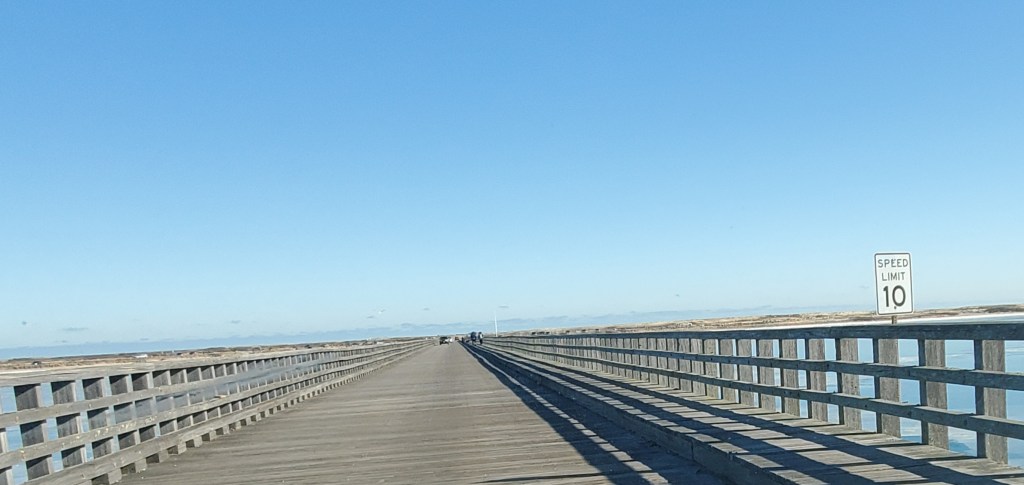
As we left Kingston, we wanted to take a scenic route that would bring us as close to the water as possible. This turned out to be Bay Road, to Washington Street, which brought us into Duxbury. We stopped once or twice to enjoy the views, marvel at some of the beautiful homes on the water, and take some pictures. When we arrived in Duxbury I set the GPS to Powder Point Bridge, which looked to be a relatively long bridge crossing the ocean. The bridge was very cool, looking more like a boardwalk for walking. I wasn’t sure what was on the other side but when we arrived there, it turned out to be Duxbury Beach, a narrow strip of land with beaches on either side. The majority of the parking was for Duxbury residents only, but there was a smaller parking lot for others. The beach area and parking lot were pretty well populated considering the time of year. We got out and walked briefly, enjoying the ice and snow on the beach and taking some more pictures before heading back to the car and back over the Powder Point Bridge.
Powder Point Bridge, Duxbury, MA
At this point we were ready to take a break from the great outdoors and headed to Marshfield and the Marshfield Hills General Store for a little browsing. It had a small sign, and we almost passed it but I spotted it at the last minute and hit the brakes to turn into the dirt parking lot. It wasn’t busy, just one or two cars other than us in the lot. We entered and gave a quick look around to see what we were dealing with. I didn’t know it just then, but we could see basically all of the store with that glance. It was very cute, a quintessential country store, albeit small. As we started to browse, I was surprised at the variety of items they had managed to include: Toys, fresh coffee, cards and gift items, baby merchandise, and a small market complete with canned goods and wine and beer. Some customers were helping themselves to the self-serve coffee and chatting comfortably with the proprietor, I’m guessing the owner. They had obviously been in the store before. I spent some time checking out the wine selection, always on the lookout for a local label when I’m in a new place. I briefly checked out the market, keeping my eyes out for a red pepper jelly that my daughter had fallen in love with a couple of weeks ago and liked to include on her charcuterie board. The market selections were more on the everyday side. I continued to circle the space, reading a couple of greeting cards and admiring a bracelet in the jewelry section before finding myself back at the door. A cute place, worth the visit, but ultimately didn’t inspire any purchases.
Our next stop–#12 on the map–was Lawson Tower in Scituate. Lawson Tower was once a water tower, built in 1902 and later enclosed by a wooden structure, on the style of a European castle turret, by land owner Thomas Lawson who was upset by the view the tower offerred. Jeanne and I share a love of backstory, so once we located the Tower, and parked, we read about the history and current use. There are 10 bells at the top of the Tower ranging from 300 to 3000 pounds. The Scituate Water Company stopped using the tank in 1988. Further googling revealed that it is sometimes opened to the Public for small events including sunset viewing.
Lawson Tower, Scituate, MA
After snapping some selfies, we checked the map and discovered we were pretty close to a “must-see” on the agenda, Scituate Lighthouse. Jeanne had been here before and agreed it was a sight we couldn’t miss. It was only a few minutes away and we found it with no difficulty. The sight has a large parking lot and although it was nowhere near filled, there were definitely other visitors present on this day. The Lighthouse is very accessible and was right at the edge of the the parking lot. A rock jetty sat behind the lighthouse and was easy walking, offering us gorgeous views of the ocean. We wandered for 15 minutes or so, snapping pictures, reading informative signs and chatting. Jeanne’s last visit to the Lighthouse, which was built in 1811, was in the evening and so she was able to see the lights in action. The lights had been out of commission for 134 years, finally being relit in 1994. The Lightkeepers cottage is right on sight.
We finally made our way back to the car, relieved that it had held some heat while we were exploring, and we were surprised to see that it was 1:30. Time for one of my favorite parts of any day trip: Lunch and a drink! We reviewed, and discarded, several eating options, based on either a lack of variety with the menu, or being a little more upscale than what we were looking for. We finally settled on The Fours, a restaurant in nearby Norwell that seemed to have a substantial menu and looked to be more pub-like than some other smaller venues.
The Fours turned out to be very popular and had a full parking lot, even at 2 o’clock in the afternoon when we arrived. Some of that mystery was solved as we entered the restaurant and discovered multiple tv’s displaying an NFL playoff game. The place was hopping and when we requested a table for 2 we were happy to accept the offer of a hightop and we were then seated immediately.
Our waitress came over quickly and gave us our menus and a friendly greeting. We both began to review our drink and dining options, which were considerable. I love a good IPA so I ordered the local Mayflower IPA and Jeanne selected a more light Blue Moon Belgian White. The food selections were more difficult as they had a great variety of appetizers, burgers and sandwiches. Everything sounded so good! We finally settled on sharing an order of buffalo chicken nachos and some chicken quesadillas. In addition, we each ordered a cup of clam chowder.
Our beers came quickly and we chatted while we sipped our drinks and enjoyed the atmosphere and each others company. The place was packed and it took a while to get our food but we honestly didn’t notice as we were having such a good time. Once our food arrived we dived right in and were not disappointed with any of our selections. We made a good choice in the restaurant and were almost reluctant to leave at about 330. But our adventure was not over yet and we were running up against limited daylight.
We began to make our way to our next Town destination, Cohasset. There was a drive I was looking forward to on Jerusalem Road that ran along the water and boasted of some beautiful mansions. On the way, there was an antique store we decided to stop at called Patina’s Antique Mall. We located Patina’s in a small shopping Plaza and were surprised from the outside at the apparent small size and also concerned as to whether or not it was open. A sign on the door pointed us to an entrance at the back of the building and when we drove around, we could see that it was a much bigger operation than it appeared from the front. It was close to their closing time and so we quickly headed into the store to check things out. It was a very typical antique location; very crowded with a wide variety of different objects mixed in together. We wanted to be respectful of the looming closing time so we moved quickly through the aisles, pausing to look at a vinyl record collection, in addition to numerous unique items. Recently I have been on the search for some colored glass items to add to my hutch, which lacks a little color. I ended up purchasing a small cranberry glass dish, which I knew would fit well with the rest of my glassware.
As dusk was starting to set in, we headed for our drive along Jerusalem Road, just a few minutes away from Patina’s. This experience was just as we had hoped, with each gorgeous residence and water view more impressive than the last. We marvelled at the size of some of the structures and wondered what size families lived there and what they did for a living. There was minimal traffic so we took our time, stopping once or twice to take some photos, before finally deciding to begin the trip home.
The day was a great success. We had beautiful blue skies and bright sun all day. Although the temperatures were chilly–between 20 and 30 degrees–we had very little wind and with our warm winter outergarments, we were actually quite comfortable out in the elements. We saw some amazing sights, got some fresh air and exercise, had a great meal, and thoroughly enjoyed one another’s company for about 8 hours. There were a few things we didn’t get to on my list of potential stops so who knows, we may try for round two of the South Shore Day Trip. Then again, there are just so many other interesting places to see!
Growing up, I had such a good memory. It’s why I did well on tests and spelling bees. I could remember your name, and the details of our last conversation. I remembered details about concerts I attended, geography facts, addresses, and phone numbers.
These days, not so much. In my other life as a banker, I work with customers every day. I might open an account for you on Monday, and if you come back in on Friday, you look familiar, but I don’t remember why. If you come in two weeks after we opened your account, you don’t even look familiar. Often a customer will pop their head into my office and ask, “Hi, remember me?” Uh, no. No, I don’t.
In talking with my similarly-aged friends, it’s not unusual. We have all had moments of thinking something is seriously wrong: Early onset Alzheimers or dementia. But when we get together and compare notes, we realize we are all going through the same thing.
But it’s still frustrating. It makes it harder to do my job when I have to look for information that I know is already in my brain somewhere. It’s embarrassing to forget something important, or worse, something you recently discussed. It’s maddening to watch Jeopardy and not be able to answer a question about a book you recently read.
There is a scientific explanation behind it. Many medical conditions can affect your memory including sleep deprivation, heart disease or dehydration. Side effects of medication can also be a cause. But for most of us, it’s just age. Deteriorating memory can actually begin as early as our twenties, and accelerates in our fifties. The main cause is the loss of brain cells. This affects both the ability to create new memories, and the ability to retrieve older ones.
So what’s an aging mom to do? Strong genes, a healthy diet, reduced stress levels, moderate exercise and limiting alcohol can all have a positive impact. Experts believe mental stimulation can also slow down the degeneration. This includes puzzles: Crosswords, jigsaws, sudoku or concentration. Other games, like chess, and cards, can also help memory by requiring you to remember possible moves from turn to turn.
There are some over the counter supplements that claim to support preventing memory loss. Prevagen is one such product. These capsules contain vitamin D3 and apoaequorin, a protein found in jellyfish. Evidence showing how effective Prevagen is, and how well our bodies absorb the ingredients, are limited. Vitamin D is a nutrient our bodies make when exposed to sunlight. While there was a study in 2017 showing a possible link to severe vitamin D deficiency and visual memory loss, further research is needed. The only thing that’s certain is that Vitamin D is essential to help our bodies properly absorb and use calcium, which is necessary for healthy bones. Studies of apoaequorin show that it acts similar to calmodulin, which is thought to play an important role in memory, although research is limited. Prevagen is not FDA approved to treat memory loss.
Other supplements, like fish oil and B6 or B12, have also been studied in regards to their potential benefits on preventing, or stopping, memory loss. No concrete benefits have been established.
Putting aside good habits, mental practices, and possible medications, we are left with simply finding ways to cope. Fortunately, I have always been an organizer of information. I’m the one who religiously read magazines and clipped interesting articles on a wide variety of topics: recipes, travel, fitness. I then filed them–yes, in a physical filing cabinet–away for future reference. I’m sure I only referred back to them on rare occasions, but when I needed to, I was glad to have them. These days its even easier to save information. A quick picture with your phone, or a screenshot, and then a “move” to a folder specifically created for that topic, takes only seconds. I sometimes even jot down some notes of information I know I might need to refer back to, and then take a picture and file it into a “reference” folder. And saved pictures are easy to retrieve. I use a similar system for information received via email and I do still have the old metal filing cabinet for original documents that I need to keep.
At work I have online folders, cheat sheets, and my ever present to-do list that is always being updated. As I think of things that need to be addressed, I immediately make a note for myself, knowing that the thought could disappear in a moment. I refer to my list several times throughout the day to make sure I don’t leave for the day with something important neglected.
I still forget things. Although I bring my list, I sometimes return from the grocery store missing the one item that caused me to go there in the first place. I sometimes am driving in my car, and forget, momentarily, where I am supposed to be going. And I know it will only get worse. So I’ll do my best to take care of myself. Keep my brain active with new activities, puzzles, reading and writing. And leave a copy of this blog where I can find it later, if I need it.
One Sentence Summary: It is possible, by focusing on even minor things that make you happy, to change, or train (hardwire) your brain to be more aware of the good things in your life, thus making you “happier”
Best Thing About the Book: Some simple tips to force yourself to focus on the positive which you can actually do at any moment in your day simply by stopping and looking around
Worst Thing About the Book: Once the basic concept was clear, it started to feel a little repetitive
Did It Make Me Want to Keep Reading: For a while, and then once I felt I had grasped the concept, I did skim a little toward the end
What I Learned: Great tips for focusing, and taking a moment to enjoy (enrich, so your brain learns to absorb) even minor happy moments (a pretty sunset, a goodbye kiss with your sweetheart, a smile from a stranger).
The Bottom Line: As a self-help book addict, this was one of my recent favorites in terms of easy-to-follow suggestions for being happier; Check out Rick’s Ted Talk!
Growing up, games were always a treasured part of my family gatherings and get togethers with friends. My immediate family of my brothers, mother and myself frequently enjoyed many board games including monopoly and chess. I have a fond memory of an afternoon spent with a retired board game called Stop Thief! and some Aerosmith playing on the turntable (yes, vinyl!). And we always looked forward to holiday gatherings when we would have a big crowd around the table ( 2 leafs inserted) to play cards, bingo, or whatever new game someone suggested we try. Add in some drinks and snacks, and perhaps some penny gambling, and it was a perfect afternoon. The Thanksgiving day would fly by as we talked, laughed, strategized, and gloated or pouted, depending on the outcome. This didn’t change as I got older. My close group of friends enjoyed nothing more than an evening at home with some chocolate chip cookies and a some 45, a local card game. Sometimes these games went into the early hours of the morning. Happy times.
I still cannot resist a good board game. If I see something that looks interesting or hear people talking about a game they’ve enjoyed, I immediately want to buy it and start playing. Thinking back to those holidays as a youngster, I realize that not everyone sat around that table playing games. I had a couple of uncles and cousins who did not join in. They were content to sit in the living room watching a Christmas special or some football. I always wondered how they could prefer that to a rousing game of pokeno! These days the players are slightly different but we still have a mixture of game lovers and non-lovers. While games are best when everyone joins in, we’ve learned to let people choose the entertainment that most makes them happy.
You will believe me when I tell you that I have a lot of board games. And many of them we don’t use any more. So I recently rummaged through the basement and decided to sell an assortment of board games on Facebook marketplace. If you’ve ever used Facebook Marketplace to sell something, you know it is very easy and convenient, but can also be a little frustrating. People will message you asking if your item is still available, and then you tell them it is, and they disappear, never to be heard from again. Or worse, they schedule a time to come and pick up the item, and then don’t show.
But it is convenient, and a good way to get a couple of bucks for those items you don’t use any more, and in all likelihood would either end up in a collection bin, or the trash. Most of the games I selected for sale were in near new condition. I put about 6 or 7 out there and offered them for $3 each. They probably go for about $20 each new. I then waited for the inevitable questions: Is this still available? Will you take $1? Are any pieces missing?
So I waited. And I waited. Crickets. Usually when a listing first goes on, it sees quite a bit of activity. You can watch the “views” and respond to any messages. Frequently I find that if it doesn’t sell in about a week, it likely never will. In most cases I have been able to sell most of my listings. In this instance, not a single inquiry.
So it got me wondering. Does anyone play board games anymore?
Turns out, the answer is yes. Pandemic and supply issues aside, board games over the past 10 years have had a modest increase and are expected to continue to increase in the coming years. Although new games continue to come out every year, the longstanding classics are still best sellers. You probably won’t be surprised to see any of these names on the top 10 best selling games of all time:
Chess
Checkers
Backgammon
Monopoly
Scrabble
Clue
Trivial Pursuit
Battleship
Candyland
The Game of Life
In 2020 topping the list was a mixture of classic, and new:
Connect Four
Monopoly
Codenames
Spontuneous
These days, I try to be very selective about which games I buy, as we don’t play as often and so new additions must be compelling! Simple is best, with few instructions and pieces. If we have any hope of roping in the usual non-players, we don’t want to lose them with complicated rules. And since we have youngsters who like to play, we don’t usually opt for games with more mature subject matter. Recently we’ve tried Exploding Kittens and Left, Center, Right, two card games with minimal equipment (just cards, and dice), and easy to follow instructions. With larger crowds, trivia games and apples to apples are family favorites.
The benefits of gathering around a table with a board game are numerous. Most importantly, it’s fun, and usually is accompanied by laughter and feelings of happiness. In addition, you are spending quality time interacting with loved ones and stimulating those relationships. Often, a new player enters the fold as our kids bring home a new friend. Playing a board game together is a great way to get to know them better. Often during game playing you will learn something new, and your brain gets lots of exercise while you plot and strategize. You will even practice your patience as you wait for your turn, or for the perfect time to spring your attack!
As we enter the holiday season, I am looking forward to this crucial element of our celebrations and I will be strategizing about which games to place on the table, taking into account my house guests: ages, level of game adoration, likelihood of laughter. Whichever game and player combinations emerge, the game portion of our holiday get togethers is certain to add more smiles to my memory bank. So if you haven’t played a board game in a while, dust off those cardboard boxes and reintroduce this great family pasttime to your holiday parties. I suspect you won’t be disappointed!
One of the biggest challenges we have as bankers, and you have as a banking consumer, is issues arising from availability and negotiability of checks. Yes, people do still write, and cash, checks. Admittedly, its much less than it used to be. In fact, according to The Atlantic, check writing in 2012 was just under 20 billion transactions versus 40 billion in 2000. Paper checks currently account for just 15% of all payments. Things like direct deposit, electronic payments, debit cards, credit cards and most recently apps like Venmo and Zelle, have greatly reduced the number of checks we write and cash. But checks are not obsolete just yet. You may not receive checks on a weekly basis, but occasionally you will: A birthday present from your gram, an insurance check from a claim, a rebate check from an overpayment or store rebate offer. So it’s important to know the items that make up your check, and the elements that may affect your ability to cash the check, as well as when those funds will be available to you.
Negotiability
Let’s start with negotiability, which means the conditions under which you can cash or deposit a check with your bank.
The “maker” is the person who issues the check. That person, or business, must complete the following pieces of information:
Date: You cannot cash a check that is dated ahead of todays date. Also, checks are generally good for 6 months, so you won’t be able to cash a check dated more than 6 months ago
Dollar amount: The amount must be filled in both numerically, and in written words, and those amounts must match; if they do not match, the written words will serve as the legal amount
Memo line: this is optional and serves as a note to the maker of the check as to the purpose of the check
Endorsement: Where the maker signs the check; a check cannot be cashed if the endorsement is missing
Payee: The Payee line tells who is authorized to negotiate the check and can be the most complicated element. It is the item that most often causes problems. Here are some possibilities and how they affect negotiability
Single payee: this is payable to one individual and can be cashed or deposited by that individual
Multiple payee: this is payable to more than one individual; the presence of the word “and” means both individuals must sign and be present; “or” means either can sign without the other; in the absence of “and” or “or,” “or” can be assumed
Double endorsed: This means that a second person, other than a payee, is attempting to negotiate the check; most banks will accept this as long as both parties –the payee and the casher–are present and identified; this most often happens when the payee does not have a relationship with a bank and is unable to cash the check on their own
Checks payable to any entity(ies) other than an individual: This includes checks payable to a business (AT & T), an association (MA Bowling League), an Estate (Estate of John Smith), or a Trust (The Smith Family Living Trust), among others. These checks may only be deposited into an account bearing the same name; often individuals will think that because they are the owner of the business, or the trustee of the trust, they can cash the check on their own; unfortunately, that is not the case. These checks must always be deposited into a like titled account
Other things that can affect your ability to cash a check include:
Identification: Most banks require a government issued, unexpired, picture ID. Most common forms of these are a drivers license, state issued ID or passport. Some banks will require a second form of ID such as a social security card, or credit card.
Customer status: While banks will cash a check for a non customer when that check is drawn on one of their own accounts, in most cases you will only be able to cash checks at a bank where you have a deposit relationship.
Availability
The next thing you may need to consider when cashing or depositing a check is availability. This means when the funds from your check are actually available to you to use for purchases. This is often referred to as “holding” the funds. Most banks make funds from cash deposits or direct deposits available to you immediately, but rules around checks are different. There are two main reasons for this. The first is that the bank has no way of knowing if the check is actually good. It could be fraudulent, or the maker might have insufficient funds to cover it, in which the check will be returned to the bank where you cashed it or deposited it, and the bank will deduct those funds from your account. Placing a hold on the check helps to ensure that those funds are in your account in the event the check is returned.
The second reason for holding the funds is that the bank does not actually receive the funds for that item until it gets back to the bank that it is drawn on. In essence, you are borrowing those funds from your bank while the bank awaits payment.
Government entities regulate how long banks can hold funds on checks. The main regulation that outlines these guidelines is called Regulation CC. The regulation sets maximum days that banks can hold your deposited checks. Check clearing has become much quicker in recent years. You may have noticed that your bank now scans your transactions, which allows the processing of the check to be completed much more quickly. Scanners are also designed to pick up on potential problems like fraudulent checks and unusually large items. This means that your bank often knows very quickly if a check is not good. They are therefore able to make the funds available to you more quickly. So although Reg CC sets limits on the number of days your bank can hold your funds, often the bank has a more generous funds availability policy.
Your bank is required to give you a copy of this policy when you open an account (Typically in your “Deposit Account Agreement”), but they will also provide it to anyone upon request. These days, most banks make funds available from checks within 1 or 2 days. Longer holds may come into play for more unusual situations such as: Large checks, checks that have been returned once already, or if your account is new to that institution. Keep in mind that these are “business” days, which do not include saturdays, sundays, or holidays. So if you deposit a check on friday, and availability is 1 business day, those funds will be available on monday. If you make a deposit on saturday or sunday, the business day of that deposit is actually monday. So 1 day availability means your funds will be available on tuesday. Availability is important to know, because if you attempt to access the funds sooner, you could be subject to fees. For example, if you make a check deposit today and then try to use your debit card today for a purchase that requires use of the funds you just deposited, you may find your transaction is declined, OR, you could be charged an insufficient funds fee, as those funds are not yet available.
There are ways to minimize worries about availability of check deposits. First, if direct deposit, or electronic crediting is available, take advantage of that as, in most cases, those funds will be available more quickly, often immediately. Also, many banks now offer ATM deposits and mobile deposits which allows you to process your check deposit after banking hours. So if you can’t make it to the bank before your branch closes, you can still deposit your check for that day. The sooner you can get your checks deposited, the sooner those funds will be available to you. Pay attention to “cutoff” times in these instances. You may have to deposit the item by 7 or 8 pm in order for it to be processed on the same day.
I hope this information is helpful! Feel free to share your questions about banking and I’ll attempt to address them in a future installment of The Answers to the Banking Questions You Never Asked.





 F Words that are not 4 Letters