What I’m Reading Now-His & Hers

Book: His & Hers

Fiction/Nonfiction: Fiction

Author: Alice Feeney

Have I read this author before: Yes, although I did not realize this initially; I greatly preferred this one to the first read I Know Who You Are

One sentence summary: Someone is murdering connected individuals and we see the progress alternately through the view of a colleague of the victims and a detective working the case, who used to be married to each other

Best thing about the Book: The number of characters (and therefore suspects) was limited, making it fun to try to guess; your guess will change frequently throughout the book as each character has motives and opportunities, and you will likely still be surprised with the ending!

Worst thing about the Book: The one minimal frustration I had was that Jack (“His”) was supposed to be the main detective on the case and he made very little progress and, in fact, rarely seemed to be conducting any investigating

Did it make me want to keep reading: Yes. I couldn’t stop and was sad when it ended, although I found the ending to be satisfying

What I learned: High school girls can be pure evil

The Bottom Line: One of the best mystery/thrillers I have read in a long time

Would I read this author again: Yes!

Next to read by this Author: Rock Paper Scissors

Soup, anyone?

Photo by Karolina Grabowska on Pexels.com

I love living in New England and enjoying all of our beautiful seasons. There really are things to enjoy about each one. Winter gets a bad reputation, but there’s nothing cozier than sitting by a warm fire with a cup of hot chocolate and watching light snow falling outside. Of course, the snow and cold can get tiresome, but just when you can’t take it any more, spring arrives, with warmer weather, shedding of heavy coats and boots, and the color green popping out everywhere. Summer might be the favorite among us New Englanders. School is out, vacations are in, and we can be outside a lot more, especially considering the longer days. While I do mourn the ending of summer, I also greatly look forward to Fall. Fall brings gorgeous foliage, great outdoor activities, beautiful scents, and best of all, great flavors. And nothing says Fall better than a big pot of hot soup.

I’ve only come across one person in my life who claimed to not like soup. The conversation came up at work. “What??” We all exclaimed, flabbergasted. “How can you not like soup?” The rest of us were dumbfounded. What’s not to like? It’s hot, soothing, and filling. Comfort food at its best. It’s also easy to prepare and generally inexpensive. Pair it with a nice loaf of bread and you have a satisfying meal.

Let’s start by defining soup. Oxford describes soup as: A liquid food made by boiling meat, vegetables and other ingredients in stock or water. Occasionally there is a debate over dishes like chili or beef stew. The consensus is that these dishes are not made with a stock or water base, and therefore, are not technically a soup. They are both delicious and should be enjoyed at any opportunity, but not part of our soup discussion today.

The next question when it comes to soup is not, “would you like some soup?” but rather, “what type of soup should we make?” Here the options are endless. According to the website Travel.com, the most popular soups in America are:

  • Tomato Soup
  • Chicken Noodle Soup
  • Potato Soup
  • Clam Chowder
  • Minestrone

Tomato soup. So simple but so satisfying. Easy to prepare, and even good straight out of a can. I find that even people who do not like tomatoes on their sandwich still enjoy the creamy flavor of a nice bowl of hot tomato soup. And if you haven’t had it with a grilled cheese sandwich you are really missing out. For variation try cutting your grilled cheese into small chunks and dropping them into the soup like cheesy little croutons. I also recently came across a recipe for tomato soup and grilled cheese casserole. Yes, it’s as yummy as it sounds. See the recipe here: https://www.tasteofhome.com/recipes/grilled-cheese-tomato-soup-bake/s.

Of course, chicken soup is famous for feeding a cold. There’s actually some science behind this long-held belief. Chicken contains carnosine which is thought to reduce stuffiness and congestion in your nose and throat. In addition, warm liquids promote hydration and clear nasal passages and the vegetables contain vitamins and antioxidants that boost your immune system. But you don’t have to have a cold to enjoy this great soup. Stick with homemade soup for this one. There is no shortage of recipes. You can go old school and cook the chicken yourself, or opt for a simpler, quicker version. Grab some saltines–cold not required–and enjoy.

If you prefer a cream based soup for your fall lunchtime meal, you might be reaching for the potato soup or clam chowder. (Chowder: a thick soup with seafood and vegetables) There are many other options in the cream family and if this is your go-to, you may have trouble deciding on which soup to enjoy: cream of asparagus, celery, mushroom, broccoli. Yum. Pair with some oyster crackers and you won’t be hungry for long.

One of the best things about soup is that you can make it your own. My boyfriend will sometimes complain that soup does not equal dinner. I disagree! I could, and often have, enjoyed many different kinds of soup as my sole dinner item. But for those who tend to agree with my BF, perhaps a more substantial soup will fit the bill. Consider minestrone. While traditionally this soup is made with beans, vegetables and a small pasta, already relatively filling, to satisfy the hearty appetites, I will often add ground beef or ground turkey. My family members are not big vegetable eaters, so when I’m making any soup, I’ll often add vegetables that are not part of the recipe: onions, carrots, peppers, celery, corn and peas can all be diced small and added to most broth based soups. I will often scan the refrigerator for fresh vegetables nearing the end of their shelf life, or leftovers from last nights dinner, to toss in the pot.

While these 5 favorites are a great start, there are so many more soups that hit my must-have lists. I am a big fan of cheese, so I cannot go wrong with French Onion Soup. The classic version with lots of caramelized onions, a chunk of bread and a melty topping of gruyere cheese, is perfection. Recently in a restaurant, I couldn’t resist a Creamy French Onion Soup. I know, right?? It was as good as you’re imagining right now. I could go on and on with many other delicious soups. Broccoli cheddar, vegetable, butternut squash, white bean and sausage. I really have to stop as I’m getting hungry and it’s lunchtime. You know what that means. Care to join me? What’s your favorite?

My Home Sweet Home Workout

I am faithful with my workouts and exercise routine but I have never had a gym membership. Does that seem unusual? I recently read that approximately 14% of the US population currently has a gym membership. That might not sound like much until you consider that that is 45 million people. Is it worth it?

I understand some of the reasons people tell themselves they need a gym membership: The gym has the necessary equipment needed; the gym offers classes and/or instruction; Paying for a membership will keep me motivated.

I disagree on all counts. Unless you are a high endurance athlete, you don’t need a large quantity of different types of equipment. There are an unlimited number of ways to get an at-home workout regardless of the type of workout you’re looking for. Cardio, weight bearing, yoga, pilates are all easily arranged at home. Your home gym can be completed with a couple of sets of differing dumbbell weights and access to the internet. My home gym includes 5 sets of dumbbells and a mat. And even the mat is optional. If you’re going to be doing floor exercises, you can use a carpeted area, or a blanket or a towel for a little cushioning from a hard floor.

In terms of putting together a workout program, there is no better resource than Social Media. My go-to recently has been YouTube. There are options here for classes, instruction, and unlimited varieties of workouts. Whether you want to begin a cardio workout or a weight bearing workout (and even if you don’t know which of these you should start with), there is a YouTube video to guide you. There are resources to help you decide what type of workout to do, how often to do it and for how long. You can search by goal (I want to build muscle, burn fat, get in shape for a marathon), by body part, by equipment type, or by time available. For example, I usually break up my weight workouts by body sections. I work upper body one day, and lower body another day. Sometimes my lower body is just legs and I’ll do abs alone on a third day. If I’m short on time, I can search for a 10 minute ab workout, and will be provided with numerous options to choose from. You can further refine your options by searching for beginner ab workouts or floor ab workouts. I have never entered search criteria for a workout and come back with no results. And if you have a smart tv, you can get your workout on the big screen.

Aside from social media options, one of the most enjoyable ways of getting gym-free exercise is to get outside. Take a walk or hike with friends, play some tennis, play frisbee, try something new! Some tips for maintaining an active lifestyle are to do things that are fun, and change it up to keep from getting bored. My favorite tip is to solicit some friends to join you. This ensures it will be fun while also having someone to hold you accountable.

The most frustrating gym rationalization to me is that paying for a membership will motivate me to work out. Unfortunately, the facts show the opposite is true. As many as 80% of gym workouts go unused. You may have experienced this phenomenon, or know someone who has. You are excited for a fresh start, attending several times a week at first (probably in January!), then less and less until you discover that 6 months have gone by, and you haven’t been to the gym once.

I suggest you find another way to motivate yourself. Here are some ideas: Regular weigh-ins, post a picture of yourself at your ideal weight, work out with a friend, place a dream outfit where you’ll see it daily. work out first thing in the morning before distractions allow you to find an excuse to skip it. With my home workouts I save time because I don’t have to drive to the gym. I can wear whatever I want and try anything new without being self conscious. And it’s easier to get back into the swing if you miss a few days. Why? Because when you’re home, you’re at the gym! Oh, and did I mention, I don’t have that unnecessary debit coming out of my bank account every month. A good, simple workout with no cost? Sign me up.

What I’m Reading Now:

Just My Luck by Adele Parks

I read a lot. I recently came back from a week’s vacation and in that time I read 2 1/2 books. Most of that happened while waiting at the airport, or on the flights. Reading is definitely my happy place. From time to time I’ll share what I have just read and give you an idea of whether or not you might like to read it by responding to the following prompts. Here’s my first selection:

Book: Just My Luck

Fiction/Nonfiction: Fiction

Author: Adele Parks

Have I read this author before: No

One sentence summary: Lexi and Jake win the lottery and soon discover the changes it brings are not all positive

Best thing about the book: My new favorite quote: “Those at the Top of the Mountain didn’t Fall There” which I have seen attributed to both Marcus Washling and Vince Lombardi

Worst thing about the book: The speed and levels at which some of the characters (mostly the narrator’s husband) succumbed and squalored their good fortune was a little unrealistic

Did it make me want to keep reading: Yes, I wanted to know how it would end

What I learned: Other than the obvious problems, the book showed some potential problems that I never would have envisioned

Will I read more books by this author: Yes, I thought it was well written and engaging

Have you recently read something you would recommend? Share it with us!

Keeping the Peace

Photo by Liza Summer on Pexels.com

You’ve probably heard that your sibling placement is often very telling of some of your personality characteristics. The first born is responsible, a leader, maybe even bossy. The baby is social, creative, attention seeking. Only children are often described as selfish, independent, and ambitious.

But I am the middle child, the peacekeeper. It didn’t help that my older and younger siblings were both boys, prone to physical fighting and arguments. I remember days of trying to keep them apart, and protecting my younger brother from being picked on by the oldest.

The trait has followed me into adulthood. I don’t enjoy conflict, preferring for everyone to get along. It’s part of why my friend tribe suits me so well. The supportive nature of our relationship means we do not argue or get into fights. That doesn’t mean we don’t disagree, but everyone is always respectful and our goal is always the same. We always wish the best for each other. Hanging with them is never tense or anxiety provoking. Not surprisingly, each of us in our group thinks of ourselves as the peacekeeper in our lives, sibling placement notwithstanding!

But conflicts exist in all other areas of my life. Household family, extended family, and the workplace. I don’t think the key players in these relationships are always conscious of my role as peacekeeper, but I find that when two people in my life are having a disagreement with each other, they both will come to me to plead their case and potentially ask for my assistance. Sometimes they just want to be heard and blow off a little steam. Other times they’re asking for me to take an active role in sorting out the disagreement. So in this way, everyone’s problems eventually become my problem.

I do prefer this role to the fighting that might otherwise ensue. I’m pretty good at finding middle ground, and understanding what works best with each party; at discovering a compromise. Part of my role as peacekeeper is always giving others the benefit of the doubt, and trying to see things from their point of view. Their behavior may seem crazy to us: How is it possible he did not notice that the trash needs to go out? Why does she feel the need to move any object on top of a surface so that the person who left it there cannot find it? Why does the colleague at work refuse to answer the continuously ringing phone, causing frustration for others?

Yes, I can understand all of these things. And part of my peacekeeping mission is to help others to understand as well. And while anyone who wants to preserve a relationship will try to make changes to please the aggrieved, it is true that we can really only change ourselves, which means changing our reactions to the annoyances of others, and learning how to ask for something different.

So, I counsel. I remind one that a teenage boy is not trying to anger those around him by failing to take out the trash. It is simply that other things in his life are more important and he honestly does not think about trash. I let someone else know that not everyone was raised in the same environment as we were, and that others may come from an upbringing where you were punished for leaving items out where they don’t belong. I gently inform coworkers that some people are not as comfortable socially as others, and that for some, handling a phone conversation can be a very daunting task.

It can be summed up, I think, as empathy. Putting yourself in the others shoes and trying to understand things from their point of view. It’s not easy, and not everyone can do it. Often people are so engrossed in their own disbelief of how others handle a situation that they cannot envision another way of thinking about it. But this is essential to maintaining your relationships. Understanding others reactions and changing your way of handling things to meet them halfway. Of course, the hope is that they will do the same to meet you half way. That is the peacekeepers objective.

While I frequently groan as I’m having a difficult day at work and receive a text from one family member, unhappy with another, I don’t really regret my peacekeeping role. I know that its better for me to have less conflict in my life, and to know that the ones that I love the most are also in a more peaceful place. We have enough challenges already as we navigate life, without a daily struggle to simply coexist with those who are closest to us. At the end of a day, I’d rather know that I helped to reduce tensions in adjacent relationships than to be sitting worried about what I’ll hear from this one or that one, or worse, have to be in the same room with two people who are angry at one another.

If you feel as though you might NOT be the peacekeeper in your life, I encourage you to join us! You don’t have to be a middle child, or a mom, or even an adult, to help bring a little more peace to your world and the world around you. Here are some best practices that have worked for me in the past:

–Encourage both parties to separate when things get contentious

–Listen to both sides

–Try to find a shared goal (we all want to live in a clean house!)

–If possible (and if not too antagonistic) have the two parties speak to one another about the specific item that is bothering them

–Have both parties suggest something they can do to help keep peace with the other

–Hold family (or work) meetings to discuss issues as a group

–When all else fails, seek professional help

These skills come more naturally to some than to others. Even though I feel a certain predisposition to my peacekeeper role, I am constantly learning new aspects and having to refine my skills. And I am not always successful. Some issues are so contentious that there is no viable resolution. And sometimes, someone is just not willing to listen. But I carry on, because having peace in my life is worth the effort.

The Answers to the Banking Questions that you Never Asked

Photo by Pixabay on Pexels.com

Part I

How much thought do you give to your banking? If you’re like most people, you probably don’t think about it a lot. Maybe you’re using the same bank where you opened that savings account for your birthday money when you were 12. Or maybe you just picked the bank that was closest to your home or workplace. Do you understand how your account works, how to avoid fees, what happens to your money if you die?

Not the most fun things to think about or talk about, I’ll agree. But important. And after 30 years in banking, I still don’t know it all. There are still situations that come up on a daily basis where I have to go looking for the answer. This is the first installment in a multi part series where I’ll tackle some of these issues based on the frequency in which I see these questions–and problems–on a daily basis in my own career as a Banker. The topics I will address today are:

1. How Banks Process Transactions

2. Debit Cards and Insufficient Fees

How Banks Process Transactions

Banks process transactions using either an online system or a batch system, or a combination of both. An online system means that transactions are processed in real time, meaning as they occur. So if you make a cash deposit at 10 a.m. and someone goes into the bank to cash a check you wrote to them, the deposit is available to cover the check. In the reverse scenario, if you needed that deposit to cover the check, your payee may get your check handed back to them to try again later.

In a batch system, transactions are processed overnight. In most cases, this benefits you, as banks almost always post credits (deposits) before debits (withdrawals). This means that you can make an ATM withdrawal at 10 am and a cash deposit at 11 am and when items post at the end of the day, your deposit will post first, making it available for your ATM withdrawal.

Within the “credit,” and “debit” categories, there is further detail about transaction posting order. Your bank may post your debit card transactions first and paper checks second. And dollar limits play a role as well. Some banks post from largest to smallest. This is good in that if you don’t have enough funds to cover all the items clearing on that day, your largest bill (maybe your rent or mortgage), will get paid first. The downside to that is that the largest item may eat up all your available funds and you could be assessed fees for every item that comes after.

Many banks now use a combination of online and batch processing. In most cases, this will benefit you. If, for example, you make a cash deposit at the ATM at 10 am, your bank may make that money available to you right away, so it hits the available balance in your account immediately. This can sometimes come in handy if you remember later that you meant to keep $20 from that money. You would be able to go back to the ATM and withdraw that right away.

When you open your account, your bank will give you a document, typically called the Deposit Account Agreement, that will explain the manner, and order, in which they process your transactions. It is valuable information to know if you have high levels of activity or tend to keep your account balances very close to what is needed to pay items. If you don’t have that agreement from when you opened your account, or if you’re shopping banks and would like to know how they process transactions, you can walk into your own bank, or any other bank, and ask for this document.

Debit Cards and Insufficient Fees

Debit cards and debit card transactions warrant their own conversation.

For those of you who use debit cards, and I’m going to guess that’s almost everyone, you may appreciate the convenience, and may have become aware of some of the potential problems. A debit card can make recordkeeping a little more challenging. While most debit card purchases show up immediately on your transaction history (possibly posting as “pending”), this is not always the case, so its still important to pay attention to your account activity so you don’t overdraw. Some places, like gas stations and restaurants, may authorize your card for an amount higher–or lower–than your actual purchase, as they don’t always know what the final purchase amount will be. When you swipe or insert your card at a gas terminal, the approval is made immediately, before you start pumping. In a restaurant they will process your card for the total of the food, and you may then add a tip, causing a different amount to be needed.

Online orders can also cause some confusion. If you order multiple items from an online store, they may only charge your debit card as items ship. So you have to remember that additional charges will be coming as your remaining items ship. This means knowing that some of the funds showing in your account balance are already spoken for.

The first debit cards were issued in 1978. My the mid 1980s they had become popular, and by 1998 they had exceeded check usage as a payment source. Banks quickly learned that they could make additional income on debit cards by “paying” items against insufficient funds. This means that when you swipe your debit card, the bank will authorize the payment, even though you don’t have enough to cover it–and then charge you a fee. If your bank does offer this service (often disguised as overdraft protection), they must give you the option to “opt out.” This means that you authorize them to decline the transaction when presented against insufficient funds. Although it may cause some minor embarrassment when this happens to you in a store, you get to walk away without having incurred any fees. You can decide if it’s worth it to pay the fee (you’re out late at night and need gas) or have the transaction declined.

Other areas where larger (and longer) “holds” are placed when using a debit card include hotel reservations and car rentals. This can more greatly impact you as the holds are often for longer periods of time and will affect your account balance, meaning you can’t use those funds while the transaction is pending. This could be for the entire duration of your stay, or rental.

Here are some best practices for using a debit card and avoiding fees:

–Make your decision about how to handle transactions against insufficient fees and notify your bank of your choice

–Monitor your account daily using your bank’s online banking platform and/or app

–Use a credit card when possible for larger, or more long term purchases like hotel or car reservations

–Avoid using your debit card for “subscription” services like netflix, gyms, or amazon as its difficult to remember when these items will hit your account and are often the cause of overdrafts

Do you have a question about Transaction Processing, Debit Cards, or Insufficient Funds Fees? Ask Me!

Be on the lookout for my next installment of Banking Questions!

Suffering the Consequences

Photo by Katerina Holmes on Pexels.com

The word “consequences” has a bad rep, and it’s probably because its always paired with the word “suffer.” But not all consequences are bad. Consequences are merely the result of making a decision about something. According to Oxford: A result or effect of an action or condition. And learning how to create positive consequences is an important lesson for our kids to learn.

So here is something I would tell my younger self: When it comes to raising our children, letting them make mistakes, and learn from them, is the best way to assist them in attaining functioning independence. I’ll be the first to confess, I was a little late to the game. My children are 17 and 19 and while I’ve tried to remember this rule as they’ve grown up, its only more recently that I’ve forced myself to take it more seriously. It continues to be difficult to pull away from solving their problems and making sure they do what they’re supposed to do. The reason for this, of course, is that we want to shield our children from failure, heartbreak, embarrassment, and a host of other unpleasant results from their actions.

My generation is the first generation to be stuck in this quandary. As I recall my childhood, and in speaking with others in my age group, we all agree: Our parents were not making our decisions for us. Nor were they lecturing us about what might happen if we did–or did not–do certain things. The “when I was a kid. . .” stories are mostly true. They kicked us out of the house first thing saturday morning, and we weren’t expected back until the street lights came on. In between those hours, they did not know where we were, who we were with, or what we were doing. They did not advise us when we left in the morning about what to do and not to do. They did not remind us of things we needed to accomplish, or dangers that might await us. When we returned home in the evenings, they did not ask us where we had been or what we had been doing. On a school day, we were not asked if we did our homework or–god forbid–if we needed help with our homework. We managed–or didn’t manage–all of these things on our own. When we reached the appropriate age, they did not tell us to get a job. We did that on our own, as soon as we were able. We knew our parents were not going to give us money, so a job was the only way to be able to pay for entertainment, and eventually, a car.

I think, in part, my generation’s need to “provide” more for our children comes from a perception that we didn’t have much growing up. My mom was a single mom, raising 3 kids. She worked full time but there was no money for extras like vacations, dinners out, cool clothes. We did not even have a family car growing up. So of course when we started having kids, we wanted them to not feel that anxiety of wearing the same 2 or 3 outfits over and over, or of having to ask friends for rides. This desire to give them more then carried over to wanting them to have more career options, make more money, have more friends. And to accomplish this, they obviously needed our guidance about many life decisions, beginning at a young age.

I’m not saying my kids are spoiled, or even ungrateful. They are good kids who appreciate what they have. But they have come to rely on me for some basic life skills: reminders about appointments, wake up calls for school or work, suggestions about saving money and paying bills. This “help,” as I’ve always thought of it, is not really helping if they’re not learning how to accomplish these things themselves. And they’ll never do that if I don’t help them learn how. And they learn by making mistakes that have consequences. Both of my kids have felt the pain of not having the money they needed for basic items like gas and socializing with friends, due to spending their paycheck as soon as they received it. This is the pain that causes positive changes for the next time.

I wonder if this need of ours to assist them in having a better life may be one reason why so many adult children now still live at home with their parents. Maybe we didn’t help them to learn how to manage things on their own: Getting and keeping a job, cooking and cleaning, saving and budgeting. Don’t worry, it’s not too late!

So when is it appropriate to step in and when to step back? The list of times you should step in is shorter, I think: Whenever an action, or inaction, is potentially physically dangerous to themselves or others. You can’t turn a blind eye to behaviors involving drugs and alcohol, or mental illness such as depression. Any of these situations require some intervention. In addition, we always want to be talking to our kids about qualities like strong morals, work ethic, and responsibilities. Ideally, we as their parents will be modeling the desired behaviors from the time they are born. I believe that seeing these qualities in their parents is possibly the best way to instill them in our children.

In terms of active teaching, from a young age we can offer options and suggest potential consequences. “You can either wear your coat or not wear it. If you don’t wear it you might be cold.” Then leave it up to the child. They may decide not to wear the coat, and will experience the cold firsthand, and perhaps make a different decision the next time. I had to step back several times when my kids were in high school. My daughter hit a rough patch with her grades during her junior year in high school. Thinking herself too far behind, she gave up. While I was not in favor of this line of thought, I let her make the call. This decision of hers did affect her options when it came time for college. Fortunately it was not tragic, just put her on a different path. She did come to look back on that time with some regrets, and probably learned a lesson that will serve her well in the future. Here are some other areas where kids can and should, make their own decisions, when they’ve reached an appropriate age. And by doing so, may learn a valuable life lesson, or just learn something about themselves:

–What to Wear

–What to eat or not eat

–What time to go to bed

–School choices (getting up on time, attendance, homework, which classes to take)

–Who to have as friends

–What types of extracurricular activities to participate in, if any

–How to spend their free time

–Driving

–When to get a job, and which one to get

–Whether or not to go to college, which college and what to study (depending on family financial situation)

Often, what I tell my kids these days is something along the lines of “I’m leaving it up to you now to. . . ” follow through on a course of action they’ve selected. I tell them that I am always available to help or talk, if asked, but that I won’t be offering unrequested advice or reminders. I’m happy to say I have recently had some proud momma moments. Like when my daughter called me to let me know she mailed a necessary form for school and made some calls to try to find a new doctor. Or when my son went and got himself a second summer job when he began to realize how expensive it is to own a car. Seeing them making these mature decisions on their own does make me happy.

If you recognize in yourself a history of solving your kids problems and trying to save them from mistakes, I’ll encourage you to rethink this philosophy. If they’re already in their teens, you have likely taught them many basic life lessons, both purposefully and through your actions. Its time to let them show you what they’ve learned, and let them learn a couple more lessons on their own. It could mean the difference between creating an adult who is still dependent on you, and a successful, happy adult.

I know which I choose.

A Solo Day Trip Might be Just What the Doctor Ordered

If you’ve been paying attention, you know I love a good day trip. From the choosing of a location, to the planning and timing and mapping out of desired stops, to discovering something surprising, I love everything about it. One of the best things is grabbing a spouse, daughter, son, sibling, friend or group of friends to share the adventure. But sometimes no one is available to join you. This happened to me recently. It was Father’s Day weekend and my kids were spending time with their dad, my boyfriend was hanging out with his son, and a quick text to my friend group returned similar responses of plans already made for that day.

Cut to me excitedly rubbing my hands together, thoughts already swimming in my head. What? I can go wherever I want? So yes, I decided to venture out on my own. Since it was early spring, I immediately knew I wanted to include some flower viewing on my agenda, so I checked my lists for places that might fit this requirement. After pinpointing a neighborhood famous for its tulip gardens, and a nearby farm boasting of its beautiful flowers, I decided on an area, about 40 minutes from my house. From there I filled in some more gaps with a hike, a local spot with beautiful trees, and a lunch stop. The only thing left was to map out my stops, fill my coffee mug, and hit the road.

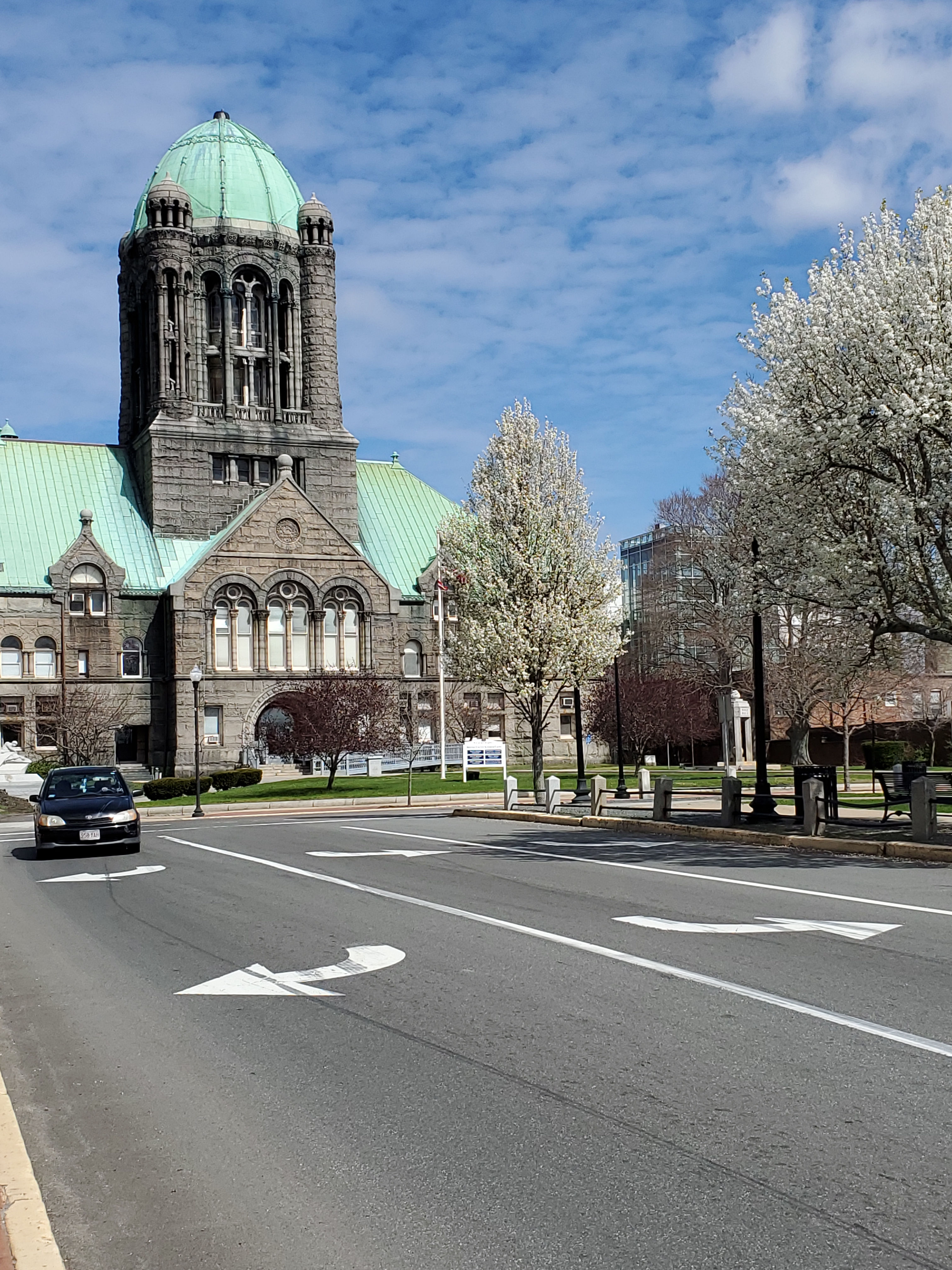
Although I often like to start my day trips with a hike, today my first stop was in the center of my hometown, where there are beautiful trees and flowers that were currently in bloom. I parked on a street and took a walk around the common, snapping pictures as I went. It was a beautiful sunny day with lots of blue skies and everything looked amazing. I spent quite a bit of time here taking photos at different angles and aiming to get some beautiful historical buildings in the background (see photo above). Already I am enjoying the fact that no one is sitting in the car, impatiently waiting for me to finish. When I was ready I hopped back in my car and drove a little further down where there is a fountain and a nice circle of tulips surrounding it. I continued to meander, taking my time and snapping pictures. Today, I only had myself to please.

Next, I headed for my hike, ensuring I get in my exercise, and also a little quiet time. This was particularly true on this day. I had selected a spot on the water but as I headed that way, I passed several additional, unplanned spring trees in full bloom so I did something I never would have done had I not been alone: I stopped randomly to take pictures of the trees lining the roads and even stopped to take a picture (discreetly) of someone’s yard! I was consciously aware of how nice it was to not answer any questions like “where are we going?” or “why are we stopping here?”

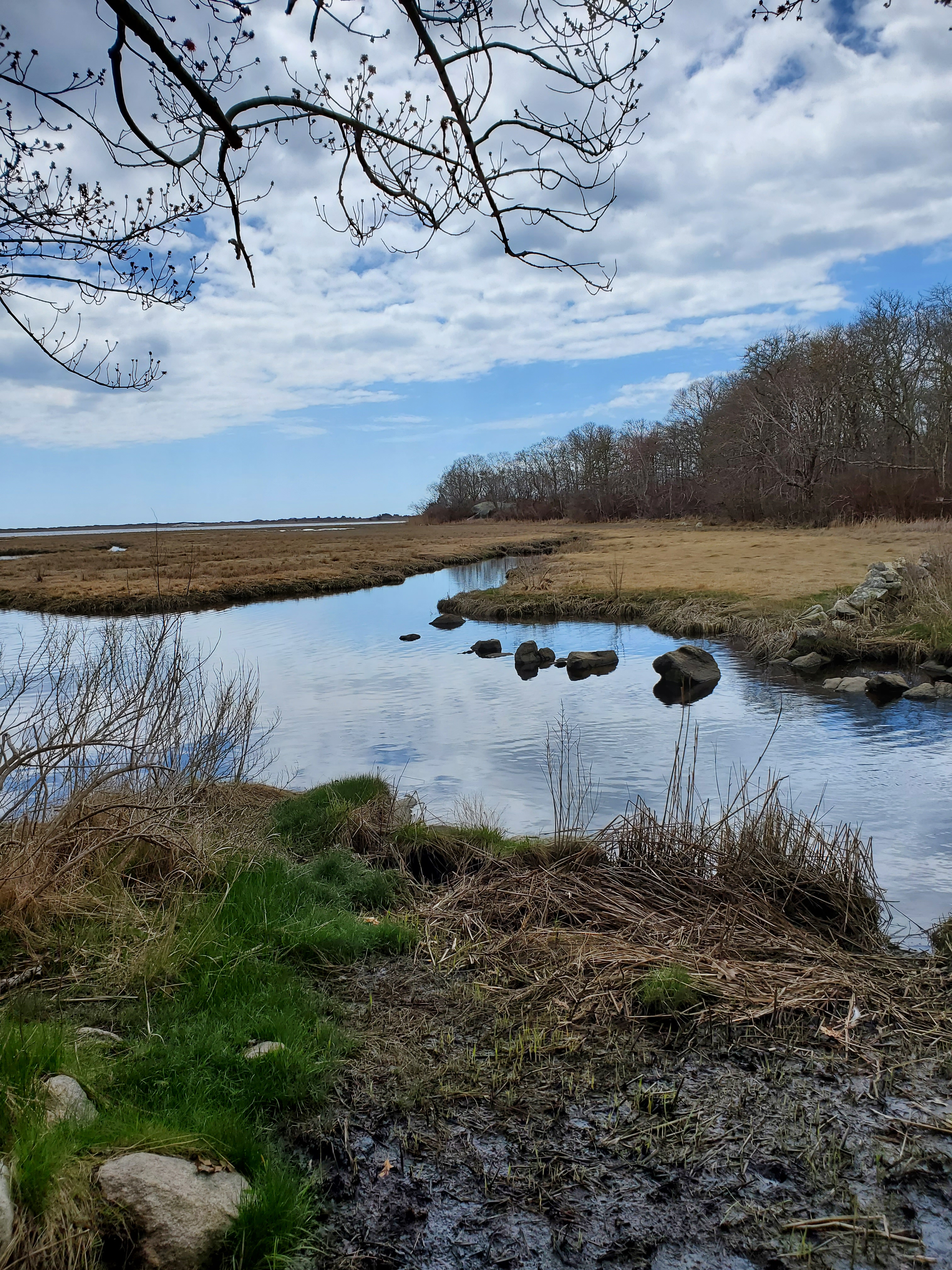
Although well behind schedule–with no one to care–I did finally make it to my planned hike, a Mass Audubon property. I had read that the main trail, which was about 2 miles long, was a loop, which I tend to prefer as it means I don’t generally have to worry too much about watching for turns and trail markers. The path should start and stop in the same spot. I set out and was immediately slowed down by the beautiful scenery and my need to take pictures. The trail started off in a large field where I saw many different kinds of birds, before disappearing into a wooded area, that I soon realized took me on a path that ran along the ocean. It was gorgeous. I’m continuing to get behind schedule but no worries, guess why? It’s just me! There’s no one else I have to please. No one groaning that I’m stopping again, or hinting that they’re hungry and its time for lunch, or that they’re tired of walking.

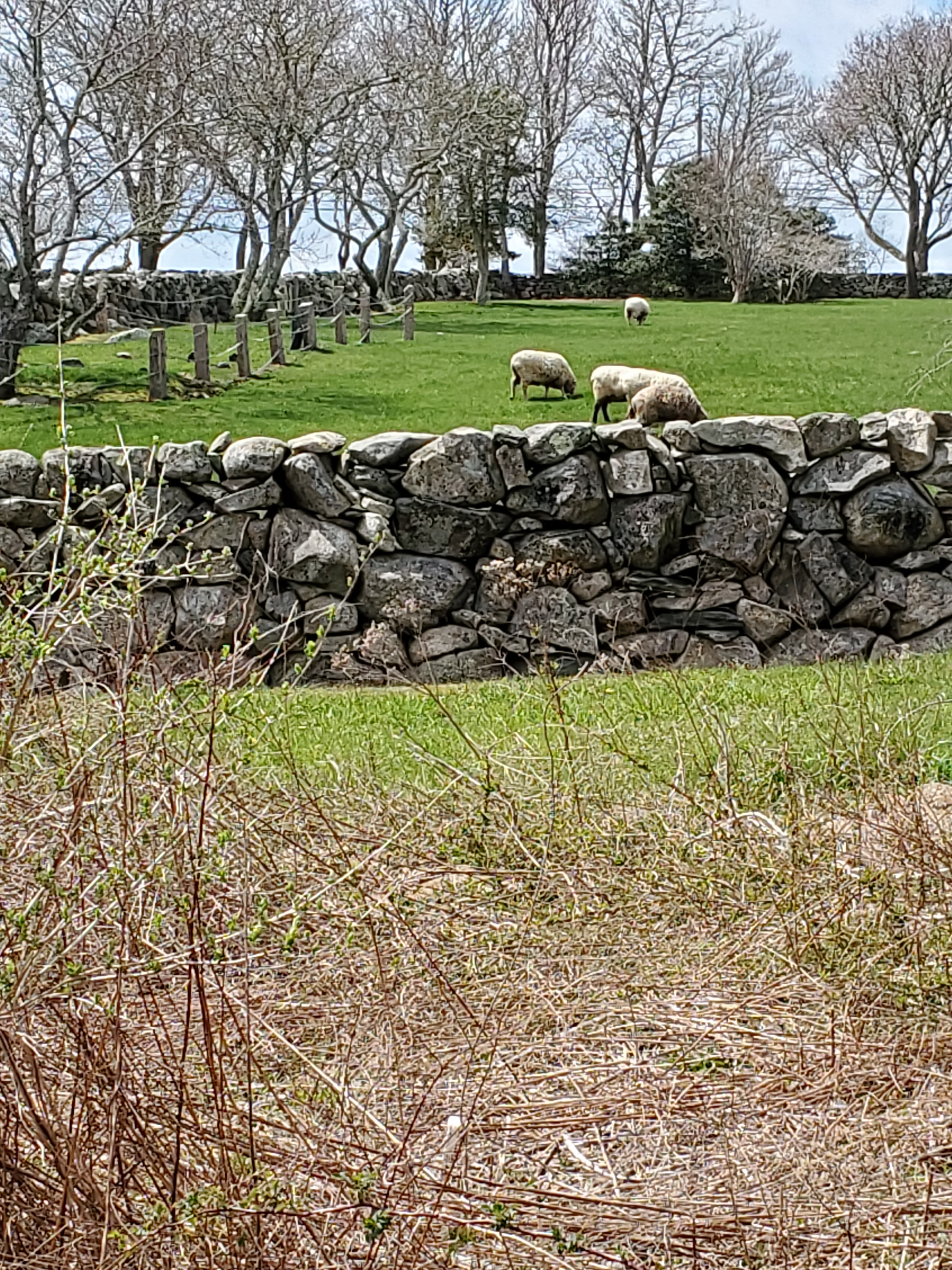
I continued on the path, which eventually led through an area where the water became a stream and there were several times when I crossed a brook via a rock bridge or wooden bridge. In a particularly muddy section, a boardwalk had been constructed to making passing easier. One spot even had a bench for pausing to appreciate the view. I passed an osprey nest with two birds in it, and a farm area complete with sheep. Around the time I thought I should be coming to the end I started to see the trail opening up and as I looked around, I realized I was not in the same spot where I had parked. It was indeed the end of the road, however, so , I had obviously missed a turn somewhere and needed to turn around. I was a little frustrated at this development as it probably meant a significant amount of time would be required to retrace my steps. However, I was once again glad that I only had to deal with my own disappointment, and not someone elses. I headed back at a brisk pace, and soon discovered where I had gone wrong, arriving back at my starting point in record time.

The next decision about where to go was, again, mine alone, and since I was hungry, lunch seemed a good option. I had selected a well-reviewed bar pizza restaurant as bar pizza is not only one of my favorites, but also is not a a favorite among my family and therefore, a good option for a day on my own. I thoroughly enjoyed my pizza–at the bar of course– and was ready to move on with renewed energy. I think if I’d had a travelling companion, this might have been the final stop for the day, having made several stops already, but I did not have a travelling companion and I still had things to see!

My last stops were the tulip neighborhood and farm. While the neighborhood was not as easy to locate as I had hoped, it was still a beautiful location and on my way I passed a couple of other signs for parks that looked like they might be interesting to visit. I was starting to run out of time so I made a note of them to investigate on another day. I made a quick stop at the farmstand, picking up some beautiful cut flowers and vegetables, before jumping back into my car for the ride home.

The day was a very enjoyable for me for many reasons: beautiful scenery, picture opportunites, good food and a relaxing flow. The main benefit was the ability to stop, change, alter, and enjoy the scenery and schedule. I enjoyed being alone, and forging my path, adjusting, altering, never worrying about what someone else would want, if someone else was bored, tired, hungry. As I look back, it was heaven. I often keep track of places I’d like to visit, and as I’m making notes of those, I’m thinking that some of these are only interesting to me, and therefore best explored alone. In fact, I’m already planning the next one. All I need now is a day to myself!

How To Read a Good Book

Photo by Karolina Grabowska on Pexels.com

Do you like to read? You must, you’re reading this right now. So what kinds of things do you like to read? I’m a voracious reader, devouring fiction, nonfiction, magazines, poetry, plays and blogs. I’ve even been known to read a cereal box. I love learning new things, being surprised or scared, and filing information away for future use. But for pure pleasure, there is nothing better for me than a good book.

First, a word on e-readers. You can’t curl up on the deck on a sunny day with a glass of wine and a kindle. I Don’t use them and never will. Like many bibliophiles, I like the feel of a book in my hands. I enjoy turning pages and flipping back to refresh my memory on a character or plot moment. I like seeing the progress I’ve made and knowing how many pages I have left to go in a chapter, or to complete the book. I most often borrow books from the library and I like knowing that someone read that exact book before me and someone else will read it after me. I like that I don’t have to charge my battery in order to read my book.

I can’t tell you what a good book is, and don’t let anyone else tell you either. Book preferences are very subjective. A good book is anything that makes you want to keep reading and makes you wish it wasn’t over when you’re finished.

I would say my current favorite genre is the psychological thriller. I don’t care for anything supernatural or science fiction. I want to know as I’m trying to solve a mystery, or predict a twist, that it’s something that could have realistically been expected to happen and not an alien or a ghost. Some of my recent favorite reads include One of Us is Lying by Karen McManus, and The Better Liar by Tanen Jones. But I don’t read these exclusively. I think even if you know exactly what kind of book you like to read, it’s always good to occasionally step out of your comfort zone and read something uncharacteristic for you. If you predominantly read fiction, don’t be afraid to add in some nonfiction. What interests you? Trust me, there’s a book about that. Do you feel you weren’t really paying attention during your high school years? History is a lot more interesting as an adult! Even a cookbook is interesting when you read more than just the recipes. And if you’ve never really been a reader of books, give it another try. You might find things have changed.

I am frequently reading two, or even three books at the same time, and usually a mix of genres. I might be enjoying my psychological thriller while also reading a work of nonfiction (recent examples include a book on parenting, relationships, intermittent fasting, and blogging). A third book might be a classic such as Great Expectations or The Magus by John Fowles. Lately I’ve also been reading a lot of classic mysteries like Agatha Christie and Sherlock Holmes.

Which book I currently have in my hands depends on where I am and how much time I have. If I’m bringing my book to the beach, I’ll be taking the “easy” read; the typical “summer” read, maybe a light mystery (Sue Grafton’s ABC series is a good choice) or the typical summer romance. I often bring a book–or 2– to work each day to read during my lunch break. I usually start by reading a work of nonfiction or a classic, and will read until it requires more concentration than I’m able to muster at the moment. I’ll then switch to the easier read. Using this method, I often will read two pleasure books to every one of other genres.

So what happens when you get stuck with a boring, tedious book? I recently started one of those romances where clearly the main characters are crazy about each other but through some misunderstanding, each continues to believe that the other is not interested. Ugh. I used to refuse to stop reading a book, no matter how difficult a time I was having getting through it, or how predictable or formulaic it was. It felt like admitting defeat. But life is too short for that. I currently have over 300 books on my pending book list, so I don’t have time to waste on something I’m miserable reading. If I mistakenly grabbed something in a genre I normally dislike, and I’m 30 or 40 pages in with nothing grabbing my attention, I will give up. Two books I recently was not able to finish were Something Happened by Joseph Heller, and The Lord of the Rings by J.R.R. Tolkien. The latter I had a feeling I would not like going in, realizing it was largely fantasy, but I did give it the requisite number of pages before calling it quits. I had read Joseph Heller in college with some interest so expected to enjoy this one, but it was pure drudgery for me. “Something Happened” is an ironic title in that nothing really happens. There’s no plot, just the narrator’s complaining about his life and family, with each of these getting a very long, verbose chapter.

How do I choose which books to read? I keep lists of course! (check out my blog post on lists!) I have a list on my phone for making notes whenever I hear about a book that sounds interesting. These can come from many sources like a book I’m reading, social media, or friends who also like to read. My local library has a nice online catalog that lets me search for books by title or author, and place holds so I can simply go in and pick up when items become available. The online catalog also has a list feature, so I can keep track of books I want to read, and move them to a hold request status as I finish the ones I have at home. If I’ve enjoyed a book I read, I will likely search the author and add more of their titles to my list.

Summer is the best time to enjoy a great book, so do some looking around, ask your friends what they read recently and enjoyed, or simply head out to your local library and peruse the stacks, picking up anything that looks good. If one doesn’t catch your interest, rest assured, there is one out there that will!

40 New Things to Try Today

Photo by Pavel Danilyuk on Pexels.com
Photo by Anand Dandekar on Pexels.com
Photo by Susn Dybvik on Pexels.com

These days, I have to stop and think about my age. Usually I’m shocked when I remember the actual number. Hint: I didn’t have a cell phone until I was in my thirties. As I think about getting older, my mind starts to wander to limitations and missed opportunities. At this point in my life I have to acknowledge that there are some things I will never do. Maybe I don’t have the time, or the money, or I’m not physically capable. It could be that in addition to getting older I have also gotten more fearful. Whatever the reason, I will never play tennis professionally, take several months to travel around the world, or sing in front of a large audience. Okay, that last one has nothing to do with age.

But there are many things I can still do. And even many things that I haven’t tried before. The same is true for you, regardless of your age. Studies show that trying new things is an important step in warding off alzheimers and other brain diseases, by helping to keep your brain sharp. Cognitive ability, physical activity, and social engagement have positive effects on memory and thinking ability as we age. In addition, people who engage in a variety of experiences retain positive emotions and minimize negative ones. Mini adventures can also lead to other non physical benefits like improved self esteem and confidence, making new friends, and even stumbling across an undiscovered talent or passion.

While we can, and should, continue to plan for the big items on our bucket list, we can start today with the small stuff. The following ideas can be tried with little advance planning, minimal time, money, or physical training. Most combine at least 2 of the characteristics that will benefit you most: Cognitive, Physical, and Social interactions. I have grouped them into 4 different categories: Learn something new, Get Social, Get Out and Explore, Put Yourself Out There.

Learn Something New

The idea here is to reach a little. Try something you’ve never tried, or only minimally tried. If you’re typically into athletic activities, try cooking or photography. Many local colleges offer unique classes. Check their catalogs. At Bunker Hill Community College in Massachusetts, you can take a 3 hour, noncredit course in Craft Cocktails and Mixology for $119. And frequently you don’t need to find anything this formal. For almost anything you want to try, there’s an online video that can show you how. Many of these items make for a great fun activity with other people, so grab a friend and broaden your horizons! Here are some other ideas:

–Bake a cake from scratch

–Tackle a home improvement project

–Take a scuba diving lesson

–Learn to play chess

–Learn a magic trick

–Take a CPR class

–Try a new sport

–Get a pet you’ve never had before

–Research your family tree

Get Social

Many options here to get together. It’s great to do things with your best buddies, but don’t be afraid to try something that will force you to meet new people.

–Join a team or club: Book club, poker night, sports team, trivia night; if you can’t locate your ideal group, start one yourself (www.wikihow.com/start-a-successful-club)

–Volunteer for something you’re passionate about

–Host an event: Dinner party, theme party, game night, scavenger hunt, larping; check out mymysteryparty.com; better yet, invite someone new to the mix

–Take a class in something you’ve always found interesting

–Meetup.com: organizes adult gatherings for like minded individuals

–Plan a day trip and invite your favorite travel companions

–Play like a kid: lasertag, paintball, hopscotch, hide and seek, roller skating, flying a kite, have a water balloon fight; challenge your kids to a contest in jumproping, hula hoops, cartwheels

Get Out and Explore

Exploring is all about getting outside and discovering new things. You don’t have to go far. There are interesting buildings, trails, boutique shops, cafes, country stores, etc, in every town in America. Start with onlyinyourstate.com.

–Go for a hike

–Try ziplining

–Find a great spot and watch the sunrise

–Attend a fair/farmers market/festival

–Go for a picnic

–Take the train/bus/ferry

–Attend an auction

–Try geocaching

–Go fishing

–Do some gardening

–Golf (full-on, mini-golf, driving range)

–Bird watching

–Paddle boarding

–Camping

–Look for covered bridges, waterfalls

–Explore a new culture: try their food, church, music, holidays, museums or historic sites

Put Yourself Out There

This is all about getting out of your comfort zone. Sure, you might feel awkward, silly, maybe even embarrassed. But it could also be a blast, and you’ll be so proud of yourself just for trying!

–Make a You Tube/Tik Tok Video

–Audition for a game show (go to a show’s website or check castingcallhub.com/tryout/game-show/

–Switch up your regular routine: If you’re a rock n roll girl, check out some live country music and line dancing; Go to the theatre to experience an unlikely movie selection; get a new hairdo, outfit, tattoo, piercing

–Try something that scares you: Roller coasters, ghost tours, public speaking

–Do something kind for a stranger

–Identify someone you’re grateful for and then tell them why you’re so happy to have them in your life

–Surprise someone who might need some lifting up: balloons, baked goods, or just a surprise visit

–Share a new interest or talent with your friends: made your first quilt? wrote a poem? Show it off with pride.

I hope this list has inspired you to try something new! You probably thought of some or your own ideas while reading mine. I’d love to hear about them. Share your ideas, and your experiences with me!