Stretching for a Loooong, Healthy Life

Photo by Jonathan Borba on Pexels.com

Do you sit up in bed in the morning and raise your arms over your head for that first stretch of the day? It’s instinctual, and there’s actually a term for it: Pandiculation. Humans, along with all vertebrate animals, tend to automatically pandiculate when we wake up or when we’ve been stationary for a while. If you’ve ever seen a cat arch their back when they get up from a nap, you’ve witnessed the pandicular response. When we pandiculate, we’re contracting muscles that have been inactive. Pandiculation is an automatic response that prepares out bodies for movement.

So, in a way, we are wired to stretch.

We’ve all heard about stretching and how important it is. But do we know why? What is actually happening when we stretch?

Stretching causes our muscles to be lengthened. Yes, it’s that simple. Stretching is regulated by the “stretch reflex”. When a muscle is lengthened, it wants to contract again. Think of an elastic band, and how once you’ve pulled it tight, it’s working to go back to it’s original position. Stretching causes your stretch reflex to subside. Your muscle then begins to adapt to a new length without aggressively firing the contract reflex. So by gently, and consistently, stretching your muscles, you’re signaling to your body and your brain that this new lengthened version is “normal.” And this new normal allows you to move throughout larger ranges of motion for day to day life with reduced injury risk.

And there are numerous other benefits to a consistent stretching routine:

Improved Flexibility: Your muscles will have a full range of motion so you can continue doing all of the activities you need and love in your daily routine and it will be easier to incorporate new movements and activities into your life

Improved Balance: You will be at a lower risk of falls and able to perform more complex moves both when exercising, and in real life situations like trying to reach something on a high shelf, or being able to do that yoga pose without falling

Improved Mobility: You will continue to be able to function in the manner you want throughout your entire life, continuing with all your favorite activities

Independence: You won’t be reliant on canes, walkers, or other people as you age

Reduced pain: You’ll be able to move as you want, without feeling it in your back and joints. Strengthening muscles and joints can also reduce back and knee pain caused from arthritis

Preparation for more physical activities: You’ll be better prepared to take on a new activity like running, where a sprinter needs to be able to fully extend and rotate their hips in order to achieve maximum speed

Releases endorphins: Those feel-good hormones can act as a pain reliever and also cause feelings of euphoria

Improves circulation: Stretching helps with circulation by increasing blood flow to the stretched area, widening the blood vessels to allow more blood to flow through. The increase in blood flow means your muscles are getting more oxygen, and are getting rid of more waste products

Stress reduction: Stretching will lead to stimulation of your parasympathetic nervous system which is responsible for rest and digestion, as well as inducing feelings of calmness and relaxation

Better posture: Muscle tightness and tension can negatively impact your posture by putting your spine into positions that can put stress on your back, neck, and core

Reduced risk of injury: Stretched muscles can help reduce injuries by improving blood flow, flexibility, and range of motion

The benefits of stretching are something you might not notice immediately, but over time you will be reaping all of the benefits as well as improving your quality of life in later years. Of course, the opposite is true. You might not be noticing any negative effects of NOT stretching–until its too late.

There are 2 different types of stretching, each accomplishing a different objective.

Static Stretching is when you hold a single position for a period of time. It requires moving a muscle as far as it can go but not so far as to be painful, holding the stretch for 20 to 45 seconds and if desired, repeating 2-3 times. No bouncing. Static stretching is best used as part of your cool-down routine following a weight or cardio workout, when your muscles are warm, to assist in reducing risk of injury and soreness. Use it also alone as a maintenance program to take advantage of all the benefits of stretching.

Dynamic stretching is a controlled movement that prepares your muscles for performance and safety. During a dynamic stretch your body is in continuous movement, as opposed to holding a single position. As with static stretches, you can limit dynamic stretches to the body parts you plan to work on that day. Dynamic stretches prepare your body for a workout by increasing blood flow to the specific muscles and preparing your body for the workout movements by going through a series of movements. Dynamic stretching has been shown to improve performance during your workout, and therefore is most effective when used after a warmup and before a scheduled workout. In some cases–such as jumping jacks–your dynamic stretch can do double duty as your warmup. Gently warming up your muscles in this way could also make your workout more effective. A typical dynamic stretching series focused on 2 or 3 muscle groups may last as little as 3-4 minutes.

Both types of stretching are most effective when muscles are warmed up, which improves mobility, blood flow, and reduces stiffness and risk of injury. And stretching can be done outside of a workout as well. It doesn’t require much time, or space, and needs no equipment. There are many stretches you can do while sitting at your desk or in front of the tv. Even standing in line or sitting in your car (but keep your hands on the wheel and your eyes on the road!) And as with your regular workout, be conscious of your breathing so you aren’t holding your breath.

There are an unlimited number of stretches that you can do, but below are some common ones that you can try to get started. If you’re already on a schedule with a workout routine, I recommend incorporating muscle specific stretches before (dynamic) and after (static) your workouts. Then try adding in a full body static stretch workout on your rest days. If you’re not currently engaging in a regular cardio or strength routine, you should still be stretching, so choose some stretches from the list below to get started.

Static stretches: Hold each stretch for 30 seconds before switching sides, if applicable.

Neck stretch: This is a stretch you can do anywhere: Sitting, standing, even lying down. Simply tilt your head to the left, with your head still facing forward, until you feel a stretch. You can use your left hand to gently press your head to one side for a deeper stretch but no jerky movements and don’t press too hard. Keep your shoulders pressed down.

Chest Stretch: Stand up straight with your body aligned in a straight line. Interlock your fingers behind your back and gently pull open your chest, keeping your back straight and your shoulders down and squeezed toward each other. For a deeper stretch, you can gently pull your arms up behind you.

Shoulder Stretch: While standing or sitting, hold one arm straight out in front of you. Gently use the other arm to pull the arm across your body until you feel the stretch in your shoulder. Some people will hook the arm with their elbow (see illustration below).

Photo by Miriam Alonso on Pexels.com

Triceps Stretch: In a standing position, raise both arms up straight. Then bend your left arm with your hand reaching behind your head, until you feel a slight stretch in your triceps. Place your right hand on your left elbow and gently push the elbow to get a greater stretch.
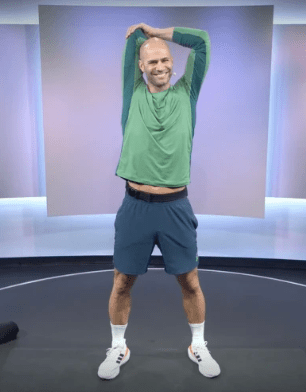
Biceps Stretch: In a standing position, raise your left arm out in front of you with your palm facing up. Use your right hand to gently pull your fingers down until you feel the stretch in your biceps.

Side Stretch: Stand tall and place your hands on your hips. Bend at your waist to the left until you feel the stretch. Be sure to continue facing forward and not twist your hips. Alternately, you can stretch your right hand over your head toward the left for a deeper stretch.

Abdominal Stretch: Lay flat on the floor on your stomach. Placing your hands flat at your sides, push your upper body away from the floor until you feel the stretch in your abdominals.

Hip Flexor Stretch: Sit on the floor with your legs in front of you. Bend your left leg at a 90 degree angle and move your right leg behind you in a bent position. Gently lean forward until you feel the stretch.
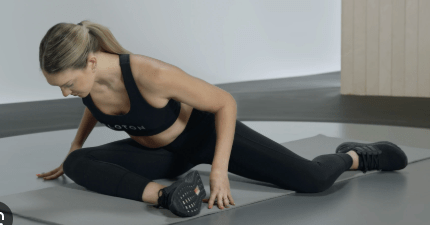
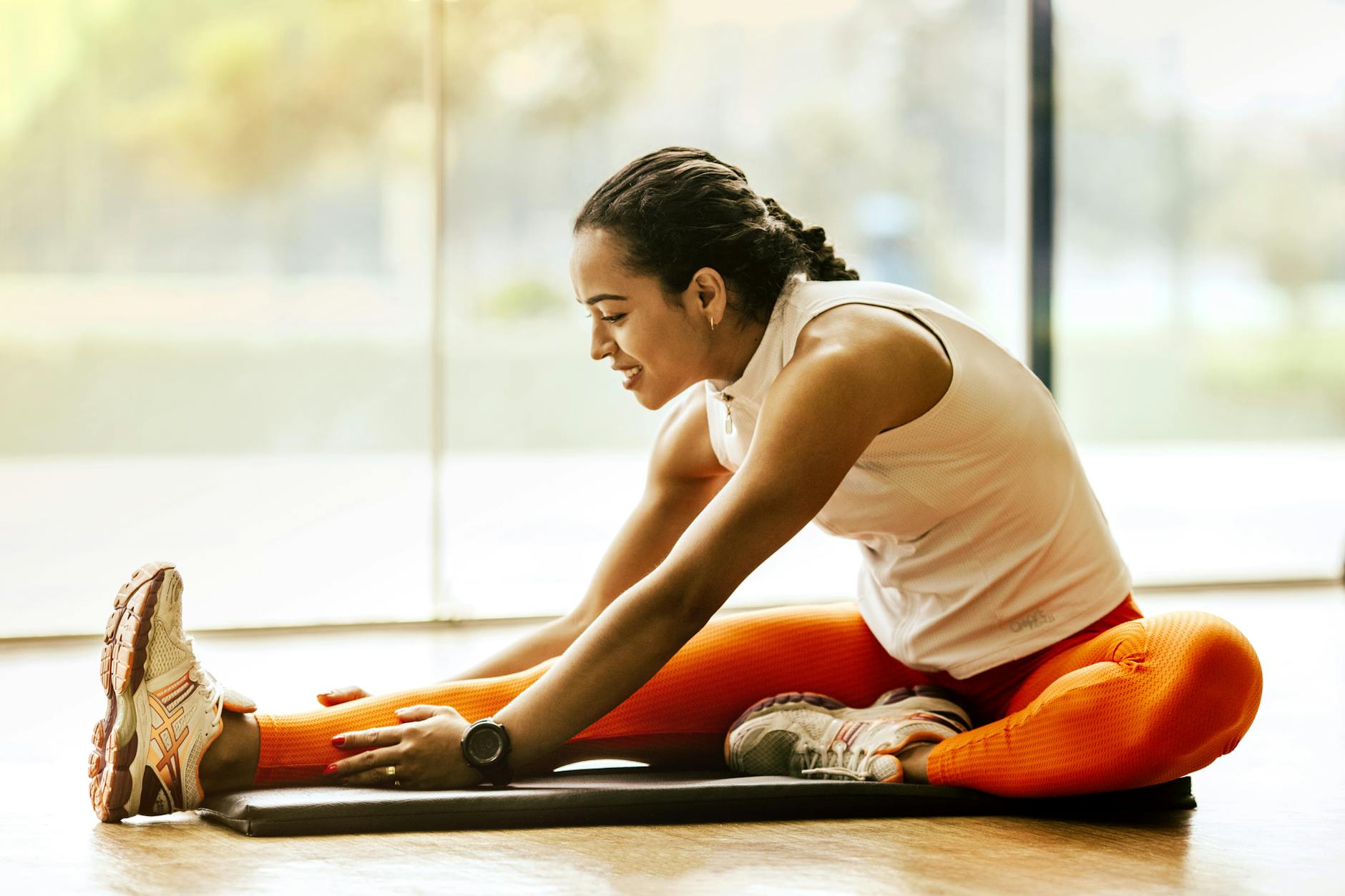
Hamstrings Stretch: Sit on the floor with your legs together and straight out in front of you. Gently lean forward until you feel the stretch in your hamstrings. If you can, you can hold place your hands under your knees or shins, or when you’re more flexible, hold onto your feet.

Quadriceps Stretch: Lie on the floor on your left side. Bend your right leg back so your foot is moving toward your bum. Reach back with your right hand and grasp your leg at the ankle or shin. Gently pull the foot toward your bum.

Calf Stretch: Stand facing a wall with your palms against the wall and your feet about 6 inches away from the wall. Step your left foot back, keeping your heel on the floor, so your left foot is straight and you right leg is bent, feeling the stretch in your left calf.

Dynamic Stretches:

Arm Circles (Works shoulders, neck, and upper back, and even a little chest, biceps and triceps): Stand straight and bring each arm straight out to the side. Rotate each arm in slow circles toward the front for 20 rotations and then reverse and rotate toward the back for 20 rotations.

Leg swings (works glutes, hip flexors, and hamstrings): Stand straight. Gently swing your left leg forward and backward for 20 repetitions. The swing the leg from side to side for another 20 repetitions.

Jumping Jacks (works shoulders, inner and outer thighs, calves and glutes): Stand straight with arms at sides. Simultaneously move your arms up and toward you head while jumping your legs apart, to form an “X.” Repeat 20 times.

Inchworm (works hamstrings, core, shoulders and chest): Stand straight with feet hip width apart and arms at sides. Slowly bend over and touch hands to floor, keeping legs as straight as possible. Walk hands forward until you reach a plank position. Reverse to starting. Repeat 20 times.

Maximizing Your Brain Power

Photo by Amel Uzunovic on Pexels.com

While you may have heard that we only use a very small percent of our brain–I’ve heard as low as 10%–turns out, that’s not true. Current thinking and studies suggest that most people actually use most of their brain. Imaging studies can see different areas of our brain being active during different functions or activities. While some portion of our brain is always active, by studying the brain during different types of activities, we can see that most of our brain is used in our daily lives. In fact, most of our brain is active during most of our daily activities.

Our brain is the most complex organ in our body. It weighs about 3 pounds and contains about 100 billion neurons that carry information to, and from, other parts of our body, at speeds of up to 250 miles per hour! The brain represents 2 percent of our body weight but uses 20 percent of our oxygen and calories. It is 73 percent water. The average brain generates 48 thoughts per minute. That’s almost one every second, and 70,000 thoughts per day!

Clearly, our brains are essential to our survival. Every single thing we will do today involves our brain: Motor function and coordination, taste, smell, sights and sounds, all of our thoughts and feelings, decision making and impulse control, functioning of all of our organs, both voluntary and involuntary, memories, and speech. So keeping our brains healthy should be a top priority. Our memory and cognitive skills actually begin to decline as early as our late 20s, so it seems pretty obvious that we would want to start as soon as possible to keep our brains functioning at top capacity, for all the years that we’ll need them. In addition to being necessary for the daily functions of our life, and being able to maintain our social connections, we also want to continue to learn and experience new things. A well-functioning brain will ensure we can learn new things, and learning new things will help to keep our brains healthy, so each reinforces the other.

Before we talk about what keeps our brains healthy, let’s talk about some conditions that can develop from an unhealthy brain. There are many types of irregular brain conditions. We often think of memory diseases like dementia when we think of brain health. Dementia is a broad term meaning decline in memory, language and problem solving abilities. Alzheimers is a condition and is the most common cause of dementia. There are numerous other conditions that are the result of a brain disorder, including ALS, autism, brain tumors, epilepsy, Parkinson’s and strokes. Some of these are present from birth, and aren’t the result of any actions on our part, while others develop over our lifetime, and may be facilitated, or exacerbated by our lifestyle. Strokes, for example, are often seen in patients with high blood pressure, obesity, smoking, and poor diet. All of these risk factors can be partially, if not completely eliminated with some healthy choices.

Brain Health is dependent on three main factors: Diet, Exercise, and Lifestyle. The good news is that these elements are also good for your body and physical health, so while you’re working on your physical health, you’re also strengthening your brain. Let’s take a look at why each of these is helpful, and what specifically we can do to maximize our brain health.

Diet:

Healthy eating in general will reduce your chances of developing diabetes, heart disease and high blood pressure, conditions that are known to increase risk for dementia. In addition, staying hydrated is very important for our brains. Remember the note above: Our brains are 73 percent water. Being dehydrated by as little as 2 percent can impair our ability to perform tasks requiring attention, memory, and motor skills. In addition to healthful eating, and staying hydrated, the following dietary elements may be beneficial to brain health:

  • Vitamin E and Beta Carotene promote brain health. For vitamin E, look for Fruits and vegetables with dark skins, such as spinach, broccoli, and blueberries. Leafy greens are also rich in B vitamins, which play a role in brain health. Those rich in beta carotene include red peppers and sweet potatoes
  • Oily fish, which contains omega 3s can help prevent brain shrinkage and support cognitive function. Seek out salmon, mackerel, and tuna
  • Walnuts and pecans are rich in antioxidants, which promote brain health
  • Dark chocolate and coffee have been shown to improve memory and brain performance
  • Caffeine can help perk you up, promote energy, and improve your focus

While no clear link has been established between certain vitamins and memory, the benefits of vitamins in general are clear. Most experts also agree that getting your vitamins from food sources is always preferable to a vitamin supplement. Supplements are not strictly regulated in the US and don’t have to prove that they work. Studies suggest they probably don’t, so skip the over the counter brain and memory boosters.

Exercise:

Regular physical exercise has been shown to boost the size of the hippocampus, the area of the brain involved in verbal memory and learning. Physical activity can also lower risk of heart disease, high blood pressure, and diabetes, all of which increase the risk for dementia. You can further improve your physical, and brain health, by mixing up your fitness routines, incorporating endurance, strength and flexibility exercises. This will not only improve your physical health, but the variety also keeps your brain sharp. Exercise will also help you reduce stress, and sleep better, both of which will keep your brain, and memory, healthy.

Lifestyle:

Aside from diet and exercise, there are other things you can do–or not do–that will benefit your brain health. Start by cutting out cigarettes and excessive alcohol. Smoking is a major risk factor for both dementia, and strokes. It can cause brain swelling, which may contribute to cognitive decline. Alcohol can impair the effectiveness of neurotransmitters in the brain, and also destroy brain cells. Alcohol can also increase your risk of mental health problems, and dementia.

Avoid multitasking. The brain can’t learn or concentrate on two things at once, but it can quickly switch back and forth between tasks and thoughts, so it feels like you’re successfully multitasking. In reality, doing so decreases your attention span, ability to learn, short-term memory, and overall mental performance. So when possible, complete one task before beginning the next. And if you know you need a relatively large chunk of time, schedule the task when you know you have a good chance of not being interrupted.

Stress and depression can cause brain shrinkage, and are risk factors for dementia. So try to reduce stress. I know, easier said than done! Meditation and deep breathing have been found to not only reduce stress and depression, but also to improve memory and attention. Cultivate relationships with the people in your life who are positive and who make you feel better about yourself, and your life. Social contact can provide a sense of connection and purpose, and just the act of conversation forces your brain to use language and vocabulary skills, further sharpening your brain. Spiritual activities such as religion, meditation and practicing gratitude have similar benefits of purpose and support and offer the same benefits as your social interactions.

Other ways to reduce stress include volunteering, and getting outdoors. Helping other people, and getting in tune with nature, are calming, feel-good activities. And don’t be afraid to ask for help. Delegate tasks if you’re feeling overwhelmed. Whether at work, or at home, there is likely someone who is willing, and able, to help.

Lastly, to reduce stress, don’t forget the best medicine, laughter! Sources of laughter can be found everywhere, including your personal friendships, a YouTube video of silly animals, or a live or recorded comedy skit. Counseling can help many of us to reduce stress. It’s good to share feelings of anxiety with someone who is not only objective, but also trained in ways to help you cope. And always seek counseling if you feel your stress, sadness or depression, has gotten worse or is seriously affecting your life.

Get enough sleep. Lack of sleep can affect your mood, energy, focus, and overrall function. In addition, memories get cemented while you sleep, so getting your 7-9 hours will help you to recall those important facts when you need them.

If your goal is to keep your brain sharp, there are strategies to improve those odds. Games are a good way to challenge your brain, and keep those neurotransmitters firing. Try crosswords, puzzles, crafts, sodoku, playing cards, and books. Studies have shown that those who used brain training exercises decreased their risk of dementia by 29 percent. It doesn’t have to be a scientifically created program. Just challenge your brain in as many different ways as possible. We’ve all had days when we drive to work, and can’t remember the drive at all. That kind of programming is not creating the new pathways that are beneficial to our brains. So your brain training doesn’t have to be superchallenging. Just shake up your daily routine with small changes like taking a different route to work, making a brand new dish for dinner, or reaching out to a friend you haven’t spoken to in a while. It should go without saying, that screentime, and in particular, social media, do NOT challenge your brain. So limit the scrolling and pick up a book, or invite your besties or family for a game night.

Most people get worried about their memory as they age. A declining memory is definitely a reality of aging, and most times is not reason for concern. Forgetting someone’s name, or why you went into your bedroom, are normal, especially as we get older. Speak to a doctor if you, or a loved one, is unable to remember the purpose of objects–like what a hairbrush is used for, or if you’re getting lost while walking or driving in an area that should be familiar–or if its affecting your ability to complete daily chores, like taking longer to complete a task that involves multiple steps. If you realize your memory issues are normal, and not signaling a more serious condition, there are some ideas you can try to improve your ability to remember, particularly in a certain area like an upcoming test, or wanting to better remember people’s names when you meet them:

  • Use images to remember facts; our brains process images faster than words, and making it silly will make it easier to remember; example: To remember the last name Rosenfield, picture the person running through a large field surrounded by rose bushes
  • Use an acronym, like RoyGBiv (the famous acronym to remember the colors of the rainbow) or use a silly phrase: To remember multiple people you met at a party: Richard, David, Sally, John, Savannah: Red Dogs Seem Just Super
  • Say it out loud: If I say, I am putting my keys on the dresser, out loud, I’m more likely to remember that later when I’m looking for my keys; better yet, tell someone else
  • Write it down or draw a picture

Our brains are vital to all facets of our lives and keeping them functioning at peak capacity will ensure that we can live our best lives. There are many things you can do every day to improve your brain’s performance, and keep it running in top condition and for the most part, the best practices for your brain will also benefit the rest of your body, and will lead to a healthy, active life for all the years to come.

Wall Pilates: Cardio and Strength Training Benefits

Photo by Anna Shvets on Pexels.com

I’ve recently started a Wall Pilates workout. Although I’ve experimented in the past with many different types of workouts: strength, cardio, aerobics, walking, running, yoga, etc, I had never tried Pilates. I think I always viewed it as something requiring a lot of flexibility, and I’ve never been very flexible. But I’ve been seeing Wall Pilates workouts and testimonies a lot lately, and it intrigued me as something that seemed doable, and that could lead to results. One of the aspects that really appealed to me, was that it seemed to incorporate both strength training and cardio, so I was very interested to see if that really was the case.

Wall Pilates is a slightly different version of traditional Pilates, which was created by German physical trainer Joseph Pilates in the early 20th century. Pilates’ goals are core strength, stability, and flexibility, and focuses on breath, cervical alignment, rib stabilization, pelvic mobility, and abs. Wall Pilates has the same focus. Pilates is practiced worldwide and is practiced by over 12 million people.

I’m not someone who goes on an exercise plan and then abandons it after several weeks. I’ve been a faithful, consistent exerciser for over 25 years. It’s essential to my life and I always make time for it. The level and variety of my workouts has definitely changed over the years. Prior to having kids, I could have hour-long strength training workouts focused on a limited number of body parts, multiple days a week. Twenty years later, my workouts are shorter, and less intense. Sometimes I’ve focused more on cardio, and other times, more on strength training. And I do like to change things up. I think novelty makes things more interesting and experts agree, it’s good to have variety and also to challenge your body in new ways.

I’ve never had a gym membership but I’ve built up enough equipment in my basement to tackle most programs. It doesn’t really take much. You could probably create enough of a challenge, and have the ability to change things up, with three or four sets of dumbbells. I also have a yoga mat, some resistance bands and ankle weights. In the past I’ve used a weight bench, barbell and free weights, but that’s not part of my routine these days. And, of course, my most important piece of equipment is YouTube. Regardless of your fitness level, or the type of workout you’d like to try, there is a video out there to guide you.

So I was excited to try Wall Pilates. As a complete beginner, I knew I would need some help getting started, and, as with most exercise programs, there are many ways to help you take the leap. Wall Pilates is no exception. There are books, apps, gym classes, and videos. While many options require a paid membership, or subscription, lots of free options do exist. Although I have always been opposed to paying to exercise, I realized I had no idea where to start with my new Wall Pilates program, and decided to purchase an app, Yoga Go, which costs about $15 a month. I also used Rachel’s Fit Wall Pilates, a free program available on YouTube.

The Yoga Go option was designed specifically for me. I answered some questions when signing up as to my preferences for workout length, fitness goals, current fitness level, and comfort level with Pilates. And I could respond each day to how I felt about the workout. Responding that it was “easy,” would mean a slightly more difficult workout the next day. I really liked this feature. Rachel’s Fit Wall Pilates gave me the opportunity to dive right in with the Day One workout. Both options advertised a 28 day program, which I thought was a good amount of time to see if I liked the exercises, and if they yielded results. In my case I was looking for some toning in my abs, glutes and thighs, with some ability to get my heart pumping, and was also looking for some lower numbers on the scale.

Requirements were simple: A yoga mat and some clear wall space. You do need a decent amount of wall space as some moves are done with your back on the floor and feet on the wall, and others are done standing, with your back against the wall. I set up in my basement and needed to remove a couple of framed photos from the wall in order to leave space for full movement. Both Programs offer good video, with verbal instructions for moves, which is good, because most of the moves were not familiar to me. I found Rachels Fit Pilates to offer more down to earth explanations, enabling me to sometimes figure out a move just by listening. But I also viewed it on my laptop, which meant that if I needed to look at the visual, I could see better than the Yoga Go app which was on my phone. I often needed to pause both versions–but Yoga Go in particular–to allow time to move between positions and figure out the mechanics of the next movement. The Yoga Go phone app workout also required me to move the phone occasionally as the workout progressed, depending on whether I was doing a move standing up versus lying on the floor. That was a little cumbersome. Another feature of the Rachels workout that I really liked, was she often showed a basic version of the exercise, and then a more challenging version, so you could adjust the workout to fit your fitness level, or your energy level on that particular day.

Neither option offered broader advice, like how often should I workout, and when, and should I alter my diet? It’s possible that that information is available somewhere in the programs, but I was not able to locate it after a quick search, and it never came up during the actual workouts. I would have appreciated something like that. I’ve always been a firm believer in rest days, and my schedule does not really allow for a workout every day. I had the impression that the 28 day programs were every-day-for-28-days which surprised me. I continued to take off days while I worked through both programs. I did complete 28 days of both programs, but it did take me longer than 28 days to accomplish that.

I like that the workouts are short, most in the range of 15-20 minutes, which allowed me to double up on some days, doing both the Yoga Go and the Rachels. Or I sometimes added a walking workout to one or the other of the Wall Pilates workouts. I also added in an occasional upper body dumbbell workout, as I felt the Pilates didn’t emphasize this as much. Rachel’s Fit did incorporate one or two days of light upper body moves with weights, but Yoga Go never did. I did often feel sore the next day, particularly with more lower body workouts, and I was sometimes out of breath, more from the strain of the movements than from high energy movements. I did find some of the moves to be challenging, both in the mechanics, and in the sheer muscle and flexibility components. If you were just watching the video, it would look easy and not very challenging, but the completion of the moves was more strenuous than I expected.

I would definitely say that there is a strength component to Wall Pilates, which is most often done with only your body weight for resistance. If you think body weight alone can’t garner results, do a few pushups, and then let me know what you think! Pushups are generally considered to be one of the best full body strength builders out there. But I agree with most experts, who say that if you really want to build visible muscle, you will need to incorporate weight bearing exercises into your daily routine. But make no mistake, Wall Pilates is still a workout. I often struggled to complete the repetitions, and felt soreness the next day. You may not be entering a bodybuilding competition following completion of the program, but it WILL build muscle, so it can change how you look. .

Cardio? While Pilates is not high impact aerobics like running or jumping, it does still improve cardiovascular health by raising your heart rate and lung capacity. When your exercises pick up the pace, or require more stamina on your muscles, you are also working your heart. I frequently found myself breathing hard even though I was performing slow movements. In addition, the slow, fluid movements and focus on breathing and proper form, can be relaxing and lead to reduced stress, which is always a win.

Pilates and Wall Pilates are easy on joints and limit risk of injury. As with any strength exercise, proper form is important, so go to a class with an instructor, or watch a video to be sure you’re maximizing your benefits and minimizing injury risk. Pilates includes a lot of stretching, which can improve your flexibility and range of motion. If you’d like to test this theory, pay attention to your flexibility as you begin the program, and then check it at the end to see if there has been improvement. One simple way to do this is with the old standby of reaching to touch your toes. Pilates is a great workout to try if you’re a beginner exerciser, recovering from an injury or an older adult. Or if you simply prefer less intense workouts.

After completing both programs, I did see some toning. Nothing drastic, and no real weight loss, but to be fair, I did not alter my diet at all, which I’m sure would have resulted in more noticeable results. I think the most telling factor is that I’m going to continue working the program, albeit selectively. The Yoga Go program will continue to get more challenging as I rate each workout, and with Rachel’s Fit, now that I’ve completed the full 28 days, I can go back and choose which workouts to do, so if I want to focus more on abs, I can do that particular workout for a period of time. I do still hope to have continued results with toning and improvement in flexibility and balance, as these are functions that can be beneficial in performing all of our daily activities. And I’ll continue to add in other types of workouts, and try new things that come along, so I never get bored with exercise, which is such an important factor in my life.

Does Exercise Improve My Weight Loss When Fasting?

When it comes to weight loss, diet is much more influential than exercise. It’s a truth I denied for many years. In my late twenties I became very active and lost weight and fortunately, incorporated exercise, both cardio and weight-bearing, into my daily routine. As often happens, I eventually plateaued, and my weight loss stopped. I always hoped that I could exercise enough to be able to eat whatever I wanted. Turns out the opposite is true: If you eat properly, you can exercise less. I recently discovered intermittent fasting, and after about a year, I think it’s safe to say that this is a way of life for me.

Simply stated, fasting is going without food or flavored beverages for a period of time. Black coffee and water are two of the limited number of beverages that will not “break” your fast. It’s important to note that fasting has many benefits in addition to weight loss. The basic premise is that while in a fasted state, our bodies not only go into “fat burning” mode, but also “cell repair” mode, which causes your body to use stored energy to clean up damaged cells and expel damaged cells and toxins from your body. In addition, fasting can reduce inflammation, improve digestive health, heart health, and brain health, all of which will help prevent disease and contribute to better overrall health as you age. Fasting doesn’t cost anything, requires no equipment, and is easy to incorporate into any lifestyle because you pick when–and how long–you fast. For more information on fasting, check out some of the books by Gin Stephens, Jason Fung, or James Clement.

Exercise is also important for many reasons that don’t include slimming down. Regular exercise can improve your mood and energy, improve sleep, and reduce or eliminate risks for many ailments including high blood pressure, diabetes, depression, arthritis, and some types of cancer. As always, talk to your doctor before beginning a new diet or exercise plan, particularly if you have a chronic health condition like low blood pressure, asthma, or joint pain.

So fasting and exercise can both be very beneficial to your health. The question I’m asking today is, will exercising while fasting improve my success rate when it comes to weight loss?

Working out during your fasting period has been shown to multiply your fat burning efforts. Research shows this number may be as high as a 20 percent increase. When exercising in a fasted state, your body has no choice but to burn calories in stored fat, rather than in food you’ve recently eaten. Insulin is the magic component that causes your body to gain weight. Both fasting, and exercising, can drive that number down. So it makes sense that combining the two will exponentially improve those results. The benefits are present in both cardio exercises and strength training exercises.

In one recent study, all the participants ate junk food every day. Some of the participants exercised after eating breakfast. They still gained weight. Another group exercised during a fasting period and gained no weight, even with the same bad diet. The benefits may be less valuable for certain types of individuals. Other studies have shown that working out during a fasting period may affect performance negatively, and may affect how well your body builds muscle, so fasted exercise may not be best for endurance athletes, or those trying to build larger muscles.

If you’re new to fasting, it is suggested that you get your body used to a fasted state before doing more intense workouts. Build up by starting with walking or cycling. And always drink plenty of water. This is important with both fasting and exercising. The diet you choose during your “eating window,” (the period when you are not fasting), will also affect your results. It’s always good to avoid sugar and simple carbohydrates, focusing more on complex carbohydrates like vegetables, beans, and whole grains. Be sure to get enough protein and healthy fats like avocado, nuts, seeds, and olive oil.

But for most of us who have incorporated either fasting, or exercising into our daily routines, it is likely safe, and in most cases beneficial to weight loss, to incorporate both of these activities at the same time.

To Walk or To Run?

If you’re someone who has ever thought about ways to stay in shape, get physically fit, or lose weight, you have very likely considered walking or running as a possible form of exercise. You’re not wrong. Both running and walking provide great cardiovascular benefits. Both can bring weight loss, and reduced risk of cancer, high blood pressure and chronic disease. Both improve endurance, circulation, and can improve mood and reduce depression. But which is actually better? The answer is not the same for everyone. It depends on your lifestyle, your health, your current fitness level, and your goals. With running, you can burn more calories in less time, but also have a higher risk of injury, both acute and chronic. With walking, you need more time to burn the same amount of calories, but also greatly reduce your risk of injury and have the added benefit of making it more social by adding a walking partner. Here’s a guideline based on some possible goals you may have.

Choose Running If:

  • You want more cardivascular benefit
  • You want to burn more calories
  • You want to lose weight more quickly
  • You want to train for a running event, or other endurance event
  • You have less time for a workout
  • You already have a baseline level of fitness
  • You do not currently have any injuries or chronic conditions, particularly in your lower body

Choose Walking If:

  • You’re just beginning an exercise program
  • You want to avoid any possible injuries
  • You want to also be social while exercising
  • You are currently obese
  • You want something that is easy
  • You want something that requires no equipment or other costs

Some other things to keep in mind if you’re going to begin a running program:

  • Get clearance from your doctor, especially if you have any physical condition
  • Invest in a good pair of running shoes
  • Always stretch before and after running
  • Begin with a warmup; walking is easy
  • Start small: A good beginning running program is to alternate walking and running; walk for 4 minutes and run for 1 minute for a total of 20-30 minutes; do this for several weeks or until the 1 minute of running begins to feel easier. Then slowly increase the running time 1 minute at a time (3 minutes walking with 2 minutes running, etc) until you’re running for the full 30 minutes
  • Alternate days of rest with your running days

Some other things to keep in mind if you’re going to begin a walking program:

  • Wear supportive shoes: you don’t need to invest in an expensive pair of walking sneakers, but you should wear shoes that have a sufficient sole to support your feet
  • Walk at a brisk pace and then switch it up: add in intervals, alternating periods of fast pace walking with moderate pace
  • Add in some inclines (hills, or treadmill)
  • swing your arms or carry small hand weights or wear a weighted vest

For either activity, be safe. Stay hydrated by drinking water before, during, and after your workout. If running or walking outside, wear a reflective vest especially if approaching or during darkness, carry ID, your phone and a whistle, run or walk in a well-lit, heavily trafficked area, and no headphones. Lastly, whenever possible bring a buddy.

Most experts will tell you the best form of exercise is the one you’ll stick with, so if you’re still unsure about whether you should select walking or running, try them both and choose the one that gets you excited enough to put on those shoes and get yourself out there!

Help Your Kids With an Early Start to Physical Fitness

Photo by Valeria Ushakova on Pexels.com

I’ve been practicing good physical fitness for about 30 years. That sounds like a long time, but I actually didn’t start to think about my health in this way until after I was married. I was relatively active as a youngster. I grew up next to a school and so had easy access to an area well suited for sports. Basketball, wiffle ball and kickball were daily occurrences while the weather cooperated.

But I didn’t really think about what was healthy, and as I entered my teen years, and socializing became a bigger part of my life, there were fewer basketball games and more card games, and I started to gain weight. I could sense my endurance diminishing in the rarer cases that I found myself needing to run, or participate in something active.

When I finally started to take my health more seriously, I had a lot of starts and stops. I did some research, set up a small gym for myself in the basement, and began teaching myself how to work out. It wasn’t easy. I know I slipped many times, telling myself I was too tired, or too busy. But I started to get into a routine. It was easier for me to work out in the evenings, so I got right to it when I got home at the end of my workday. I alternated cardio (back then we called it aerobics) workouts with strength training, spending 30-45 minutes a day. I started to see results. And I liked it. My arms were more defined, and I had abs! I slowly lost some weight and I felt great. I became addicted to the way I looked and felt.

My workouts have changed frequently over the years, sometimes more intense, sometimes less. Sometimes a greater focus on cardio, sometimes strength training, but I have always maintained a schedule and a routine. I might take a week off during the busy holiday season or when things are crazy at work, and I have changed my workouts to mornings now, but staying physically active is still a big, consistent part of my life.

One thing I’m certain of: It is much easier to stay in shape, than to get out of shape and have to get back in shape. So I frequently wonder, would things have been easier if I had started my journey to physical fitness earlier, as a child? And would the benefits have been greater?

Many of the ailments that plague adults, such as diabetes, high blood pressure, and obesity, have their roots in early childhood. By starting an exercise routine early, these maladies can often be avoided. So it seems to make sense that teaching kids about physical fitness at an early age is a great idea.

Children are the recipients of the same physical benefits as adults when it comes to both cardio and strength training exercise:

  • Increased strength and endurance
  • Increased flexibility
  • Improved posture
  • Increase metabolism
  • Enhanced motor skills

In addition, there are numerous non-physical benefits that can be particularly helpful to children:

  • Psychological well-being
  • Improved sleep
  • Setting, and working toward goals
  • Improved self-esteem

So how can you, as a parent, get your kids on the right path? Kids naturally love to move and play, so encourage this whenever possible. If their screen time seems to be higher than usual on a particular day, head outside for a game of tag or hide and seek. If the weather is preventing you from going outside and you’re looking for some indoor inspiration, check out kids workouts on YouTube. With your smart tv you can display the workout on a big screen and the kids will feel like they’re attending a fun class. Here are some more suggestions to help you get started and stay on track.

  • Make physical activity part of your daily routine, from the time kids can walk
  • Engage in lots of active play time both indoors and outdoors
  • Try lots of new activities and make it fun
  • Let them know about the benefits of staying active and how they’re keeping their bodies healthy
  • Make it part of a daily routine much like eating, brushing teeth, and sleeping
  • Exercise with them and emphasize benefits like improved strength and endurance

As they get older, you can make physical activity more structured: Okay we’re going to work out now so our bodies stay strong and healthy! Kids as young as 6 or 7 can understand a routine and also benefit from more structured routines, like strength training. If you’re not sure how to start with something like this, find an online resource to be sure you’re doing it safely. In particular always:

  • Consult with a doctor before beginning a strength training routine, especially if any medical conditions exist
  • Warm up and stretch before exercising
  • Use proper form
  • Stay hydrated
  • Be sure to take days off between strength training workouts
  • Don’t forget to breathe!

No matter the age of your kids, you can still institute some healthier habits. If they’re a little older you may need to start slowly with small changes, or exploit an activity you know they already enjoy by offering to take them to the skate park or basketball court. Like most behaviors, a good role model is the best teacher, so let them see you being active and exercising even on days when you can’t convince them to join you. By building these good habits early, you’re helping them to be healthy and preventing undesired medical conditions like obesity, diabetes and high blood pressure. In addition you will likely see their confidence and self-esteem improve as they see the benefits of regular exercise. So what are you waiting for? Go grab your kids and get active!

My Home Sweet Home Workout

I am faithful with my workouts and exercise routine but I have never had a gym membership. Does that seem unusual? I recently read that approximately 14% of the US population currently has a gym membership. That might not sound like much until you consider that that is 45 million people. Is it worth it?

I understand some of the reasons people tell themselves they need a gym membership: The gym has the necessary equipment needed; the gym offers classes and/or instruction; Paying for a membership will keep me motivated.

I disagree on all counts. Unless you are a high endurance athlete, you don’t need a large quantity of different types of equipment. There are an unlimited number of ways to get an at-home workout regardless of the type of workout you’re looking for. Cardio, weight bearing, yoga, pilates are all easily arranged at home. Your home gym can be completed with a couple of sets of differing dumbbell weights and access to the internet. My home gym includes 5 sets of dumbbells and a mat. And even the mat is optional. If you’re going to be doing floor exercises, you can use a carpeted area, or a blanket or a towel for a little cushioning from a hard floor.

In terms of putting together a workout program, there is no better resource than Social Media. My go-to recently has been YouTube. There are options here for classes, instruction, and unlimited varieties of workouts. Whether you want to begin a cardio workout or a weight bearing workout (and even if you don’t know which of these you should start with), there is a YouTube video to guide you. There are resources to help you decide what type of workout to do, how often to do it and for how long. You can search by goal (I want to build muscle, burn fat, get in shape for a marathon), by body part, by equipment type, or by time available. For example, I usually break up my weight workouts by body sections. I work upper body one day, and lower body another day. Sometimes my lower body is just legs and I’ll do abs alone on a third day. If I’m short on time, I can search for a 10 minute ab workout, and will be provided with numerous options to choose from. You can further refine your options by searching for beginner ab workouts or floor ab workouts. I have never entered search criteria for a workout and come back with no results. And if you have a smart tv, you can get your workout on the big screen.

Aside from social media options, one of the most enjoyable ways of getting gym-free exercise is to get outside. Take a walk or hike with friends, play some tennis, play frisbee, try something new! Some tips for maintaining an active lifestyle are to do things that are fun, and change it up to keep from getting bored. My favorite tip is to solicit some friends to join you. This ensures it will be fun while also having someone to hold you accountable.

The most frustrating gym rationalization to me is that paying for a membership will motivate me to work out. Unfortunately, the facts show the opposite is true. As many as 80% of gym workouts go unused. You may have experienced this phenomenon, or know someone who has. You are excited for a fresh start, attending several times a week at first (probably in January!), then less and less until you discover that 6 months have gone by, and you haven’t been to the gym once.

I suggest you find another way to motivate yourself. Here are some ideas: Regular weigh-ins, post a picture of yourself at your ideal weight, work out with a friend, place a dream outfit where you’ll see it daily. work out first thing in the morning before distractions allow you to find an excuse to skip it. With my home workouts I save time because I don’t have to drive to the gym. I can wear whatever I want and try anything new without being self conscious. And it’s easier to get back into the swing if you miss a few days. Why? Because when you’re home, you’re at the gym! Oh, and did I mention, I don’t have that unnecessary debit coming out of my bank account every month. A good, simple workout with no cost? Sign me up.

Stop Procrastinating! (But read this first)

I’m sorry. I would have had this posted sooner, but. . . I procrastinated. Oh, do you sometimes procrastinate too? Procrastination is defined as the action of delaying or postponing something. We all do it at one time or another. The “why” is not really a mystery. It’s usually an onerous task that gets put off: A lengthy project at work, beginning an exercise program, a difficult conversation. We might be afraid of failure, or embarrassment. We might just dread the sheer work, or amount of time required. But most of us also know that we usually feel better after getting a difficult task completed, or at least begun. And we also feel a sense of pride for tackling something that was scary, or difficult. This is a much better feeling than the feeling of not having tried.

If you’re okay with your occasional (or habitual) procrastinating, then you can stop reading now. But if you’re looking for some motivation, and some practical suggestions, I’d like to share some “dos” and “don’ts” that have helped me overcome that desire to put off until tomorrow what one can do today!

DO: Find your Mantra

Positive thoughts and affirmations do help. For procrastination, I like “Action is better than Inaction.” You might need something more energetic like “I can do it!” When my kids were younger and playing sports, I liked to channel Wayne Gretzky who said “You will miss 100% of the shots you don’t take!”

DONT: Torment yourself with all the things that could go wrong

Not everything will run smoothly, but you learn from the mistakes and move on. Eventually you will get where you want to be. Have you been putting off a difficult conversation with a coworker, friend or family member because you’re worried how it might go? Think about how having the conversation will improve the situation and very possibly improve your relationship going forward. And even if it doesn’t, you’ll know you did everything you could to fix it.

DO: Schedule the task you’ve been avoiding for first thing in the morning

I frequently have to make difficult phone calls at work. Those are the first things I tackle each morning; before reading emails or chatting with coworkers. After that, I can relax as I tackle the less strenuous aspects of my day. When should you tackle that DIY home project? On your next day off. Write it on your calendar for a specific day and time and then keep that appointment. The phone call to check in on a friend whose going through a difficult time? Right now, while you’re thinking about it!

DONT: Wait until you have exhausted all research/ explored every possible outcome

There is such a thing as over planning and over thinking. If you need to plan your family’s summer vacation, brainstorm 3 or 4 possibilities and then do a little digging to see which makes the most sense. Any more than that will be overwhelming and will keep you from making a decision. Trying to quit a bad habit? Choose between 2 or 3 options that will help and get started. At some point you have to jump in to find out what it is that you haven’t thought of.

DO: Prepare the night before

If you want to start a new workout plan, decide the evening before which workout you’ll be tackling, what time you want to start, what equipment and/or clothing you’ll need. That way when you wake up, you’re ready to go, and you don’t talk yourself out of it while thinking about all those choices.

DONT: Give up if things don’t work right away

If you finally nailed an interview for a new, more desirable job, and you don’t get selected, try again! If nothing else, that first interview provided great practice for the next one.

DO: Think about how good you’ll feel when you’ve finished

Reference a time in the past where you were proud, happy, rewarded for getting to the task completed! I once was working on a magazine article and procrastinating the phone call to request an interview with someone who was clearly an intelligent, sophisticated person. I was nervous and intimidated. I finally selected a day and time, and mustered the courage to make the call during my scheduled time. To my surprise I got directly to the person I needed to speak with and convinced my target to conduct the interview over the phone then and there. Although this was about 15 years ago, I can vividly recall the feeling of euphoria I experienced when the challenge was completed. Writing the actual article was easy from that point on.

DONT: Spend a lot of money on supplies

If you’re working on a new project for the first time, ease into it. If you’re thinking about learning how to quilt, start with the simplest pattern and least expensive material while you assess your interest, talent, or the expense before buying a lifetime supply of materials.

DO: Define your objective

Reminding yourself why you’re doing something can often be the best motivating factor. If you’ve been putting off scheduling that appointment with the doctor, focus on why you’re doing it: Making sure you’re in the best shape to continue enjoying your life to the fullest, and being around for the people who love you. That work project could lead to a promotion, organizing your clutter at home could lead to enjoying your home more, getting that dating app might lead to a great relationship.

DONT: Make excuses

I don’t really need to explain here, do I?

DO: Ask for help

You probably have people who would love to help with your project at work, or home, or another personal challenge: Run your first 5k? Get involved with a volunteer organization? Choose the individuals you know will encourage you, hold you accountable, and follow through on their end of the agreement. Not only can they help you attain your objective, but the journey will likely be more fun.

DONT: Let yourself be distracted

This can be one of the quickest derailers of your well-thought-out plan. If you’re working on something at home, pick a quiet spot and if possible, a time when no one is at home, to reduce interruptions and outside demands on your time. At work, let your colleagues know when you’re working on something and would prefer to not be disturbed. Close your door, shut down your email and let calls go to voice mail.

DO: Commit to working on the task for 15 minutes

You can do anything for 15 minutes, right? If it’s not working after 15 minutes, take a break and schedule to pick it up again the next day. More than likely, you’ll find that you get into a flow and can easily put in more than the 15 minutes.

DONT: Overschedule

You won’t get that entire project done in under 2 hours. And don’t schedule it behind another project, or on a day that is already filled with other commitments. The tasks you tend to procrastinate need a dedicated day with plenty of time. This will minimize the stress and ensure this important activity gets your full attention.

DO: Break larger tasks down into smaller sections

If you’ve been putting off the overwhelming task of doing your Estate Planning, start with one piece: Finding a sample will, deciding on your largest assets, completing a Health Care Proxy. Even the most intimidating tasks are manageable in smaller chunks.

DONT: Overpromise

Your boss asks for a volunteer and you raise your hand. What were you thinking?? Ask questions so you understand what’s expected, then be specific about what you will deliver and be realistic about the timeframe for completion. If things aren’t going as planned, don’t be afraid to ask for more time.

What? You’re still reading? Stop stalling and go conquer that top item on your list. And report back, I’d love to hear about it!

The Perfect Exercise. . . For Me

Exercise is a very personal matter. When, where, what type, what duration, what intensity. These are all very individual preferences and decisions. No one can tell you what will work best for you, simply based on what has worked for them. And you do hear a lot of conflicting information about what is best. Cardio or strength training? Long sessions or short bursts? Heavy weights or high repetitions? Gym or home?

I have done a lot of reading, experimenting and rejecting of exercise in my day. And I have learned that there are 2 basic truths:

  1. Exercise is good
  2. The BEST exercise is the one that you will actually come back to again and again

I suspect a lot of you have, at one time or another, obtained a gym membership. Maybe you’ve embraced these workouts, developed a schedule, made notes of your progress. Or maybe, you attended faithfully for the first month, then once or twice over the next several months, and finally, the only gym related activities you’re involved in are watching them debit your checking account every month.

So keep trying anything that is not dangerous, especially if its interesting to you. Many things won’t stick, for any number of reasons. But occasionally, something will, and it may become a part of your life for many years to come, or maybe even forever.

One such activity, for me, is hiking. “Hike” is defined as “to walk or march a great distance, especiallly through rural areas.” Pretty broad and wide reaching definition. Which sort of sums up hiking for me.

I fell in love with hiking over 20 years ago. At that time the motivation was the reward at the end of the trail. I climbed to my first stunning view of the White Mountains and I was hooked. Knowing that vista was waiting for me was enough to keep me climbing. Each time you attempt a different uphill hike, the view is different, but spectacular. To this day I have still not gotten used to, or bored with, the view you can get from such an altitude.

Aside from an amazing view at the end, there are so many other beautiful things to see: Wildlife like deer, snakes, birds, beavers and dams, and butterflies; amazing variants in trees and flowers; tunnels and caves; streams, rivers, and beautiful waterfalls. I remember one hike my friend Jeanne and I took with our husbands at the time which was a very difficult, constant uphill journey. Once we reached our destination we were surprised to find a gorgeous swimming hole. The guys stripped down to their underwear and we all enjoyed cooling off in the water before heading back down. A great adventure and a forever memory.

Sometimes there’s a known structure you might be heading for, or something unexpected. Stone walls are very common. On well travelled trails there might be a boardwalk to cover muddy areas, or a footbridge to cross a stream. Remains of something larger can often be found. Homes, castles, cemeteries, plane wrecks, towers, even whole villages are out there waiting to be explored. It’s not difficult to find such spots if you do a little digging.

Gorgeous sights at every turn are not the only reason I fell in love with hiking. Hiking can be any level of physical exertion that you wish. You can find a flat, wide path around a small pond with very little elevation or rough terrain. Alternatively, you can attempt a steep climb that will use every muscle in your body and leave you breathless at the top, and sore the next day. Or you can find any level in between. And you can choose not only the exertion level, but also the length of time you spend, from the 10 minutes it will take you to hike from the parking lot out to Doanes Falls in the Berkshires in Massachusetts, to an overnight, steep trip climbing Mount Washington in New Hampshire. In every case, its great cardiovascular exercise, and in many cases, also a challenging leg workout.

If the scenery and workout benefits aren’t enough of a reason, hiking can also offer a sense of peace that you will find nowhere else. I rarely hike alone–only on well-travelled, smaller, flat trails, with other people around and minimal chance of an injury–but when hiking with a partner like my boyfriend, Jay, we can walk along for periods of time in complete silence, literally leaving the hustle and bustle behind us. And, interestingly enough, if you seek the opposite, some social interaction, hiking is also ideal for that. Recently, during covid days, my friends and I would meet on a saturday or sunday morning for a hike in the woods where we could catch up, share some laughs, and still get in some much needed fresh air and exercise.

I’m sure it’s easy to see why hiking is my preferred method of exercise.

Itching to get started? When you are planning some hiking, be sure to do your homework, and be prepared. Figure out what type of hike you want to attempt and find a good spot. Alltrails is a popular app that lists hundreds of trails within driving distance and will give you the information you need: terrain type, level of difficulty, how long it should take. In most cases you’ll even find a map to help make sure you don’t get lost. Its good to familiarize yourself with the details of the trail before you start out. Take it from someone who gets lost easily, and has gotten lost several times in the woods. This is especially true if there are multiple trails in the area. You want to know which trail you are following and know which way you need to head if you come to an intersection or your 30 minute hike can quickly become a 2 hour hike. If possible, take a screen shot of the trail as you will often not have a signal on your phone once you’re out on your hike in the woods.

Be prepared to be comfortable with whichever type of hike you choose. Comfortable clothing and shoes are a necessity. A short, flat hike can be attempted with regular walking shoes or sneakers. When attempting anything uphill, or rocky, you’ll want a sturdier, traction shoe or hiking boot. Will it be cold or rainy? Plan for that. Bring water on any length hike, and snacks for longer hikes. You’ll want a comfortable backpack for your supplies. Lastly, bug spray is essential, particularly something to combat ticks, which are inevitable in the woods.

Hiking has it all: A Peaceful, short stroll in a beautiful environment or a heart-pounding, longer workout with lots of chatter and companions, you can alter hiking to any energy level, social level, timeframe, and goal. To pick out your first hike, identify the element that is most important to you and use an app, or an online search to locate options close to you. Or keep an eye on my blog, where I’ll be featuring some of my favorites in the future. In the meantime, if you’re looking for me, I’m probably on the trails.

How to Plan the Perfect Day Trip

Clockwise from top left: Brewer Brook Trail, Wachusett dam and reservoir, Interior-Clinton Tunnel, Exterior-Clinton Tunnel

I’ve always enjoyed a good day trip, and in this past year I’ve turned my interest into an art form. For me, a day trip is the perfect way to see new, interesting places, enjoy beautiful sights, and connect with friends or family. Don’t get me wrong, I long for future days of Caribbean and European vacations, as well as long weekends away. But for now, a day trip is an inexpensive way to rejuvenate and have some fun.

I’m going to share my planning strategies and a recent day trip adventure. And in case you don’t enjoy the planning piece of it as much as I do, follow my blog as I’ll continue to share preplanned day trips you can take in the future.

I am lucky enough to live in Massachusetts. There are many things I love about New England, but topping that list is the ability to quickly travel by car to several different states. In addition to MA, I can easily be in Connecticut, Rhode Island, New Hampshire, and even Maine or New York for a longer day trip.

When I decide to plan one of these adventures, I figure out how much time I have for that day, and who my travelling companion will be. My fellow traveler is important as I try to plan activities that I think they would enjoy. For example, if my daughter Bridget is going to join me, I’ll plan to visit thrift or antique stores.

Once I’ve identified my co-pilot, I start to peruse the ongoing lists that I maintain of possible places to visit (for more on my list compulsion see my recent blog “A list for the lists”!) I’ll pick out one or two activities that match my guest, and timeframe for travel, also taking into account seasonal activities and weather. Once I’ve identified that my top activities are feasible for that day, I might google the area or trip advisor to fill in some more possible stops. You might just like to wing it and drive out there and see what ‘s what, but I personally like to have at least 3 ideas of places to stop prior to heading out for a long drive. Honestly, I usually plan more items than we can feasibly accomplish. This allows for surprises–such as rain, or a spot being closed unexpectedly–and it also allows my travelling companion to have some say in what we do. I can show them the list of possibilities and let them select their favorites.

If I’ve found 2 or 3 main activities and I know we’ll have more time to spend, I’ll fill in with some favorite activities by googling the area by topic: Country stores, hikes, and restaurants top this list of possibilities.

Lastly, I print a map (yes, paper!) of the area and mark our potential stops. This gives me a better idea of how much time we’ll need, and also will help me plan the order of activities so we aren’t constantly backtracking because we aren’t sure which activity is closest.

After this, the only thing left to do is pack some snacks and hit the road!

Here’s how a recent day trip went with my 17 year old son, Dylan, during his recent school vacation. Dylan and I had about 5 hours to plan on this day. Rain was predicted late in the day so I knew I would want to schedule any outdoor activities earlier in the morning. As I started to review my list of ideas, I kept in mind that Dylan likes to see unusual things, especially if they might be spooky, and he also loves taking pictures. After running down some ideas, I decided to begin with an abandoned railroad tunnel in Clinton, MA. This offered both photo opportunities and an eerie atmosphere that I thought he would like. Also added to my list was the Wachusett dam and reservoir which looked interesting and appeared to be close to the tunnel. After this, I searched the area for a picturesque hike that would be close by, as I love starting my day in a peaceful environment with pretty surroundings and the opportunity for a little exercise. This search yielded Brewer Brook dam trail, in nearby Berlin, a 1 1/2 mile, relatively easy trail around a small lake. I figured these 3 activities, followed by a nice lunch, would make a great day. I mapped out the locations, filled Dylan in on the plan, and declared a 9:00 a.m. start time.

I was very happily surprised to awaken to a beautiful, sunny day. Since I’m an early riser, I had plenty of time to pack up some snacks and water, as well as making sure I was prepared for rain or mud (on our hike) by packing a sweatshirt, umbrella, and boots. Based on the map I had created, our itinerary looked like this:

1 Hike at Brewer Brook Trail

2 Clinton Rail Tunnel

3 Wachusett dam and reservoir

4 Lunch at restaurant of Dylan’s choice

We left at about 9:15, almost on time! Not bad for a morning trip with a teenager on spring vacation. Our first stop would be the hike, and GPS had us arriving there in about an hour. We had a relaxing drive with minimal traffic and located the parking area for the trail fairly easily. The trail map in the parking area showed an easy loop around a pond, so we set off with our cameras ready. The trail appeared well traveled and well marked. We came quickly to the lake and noticed in the water a teepeed fencelike construction, and when I wondered what it could be, Dylan had already figured out that it was an outlet that the water fell into (photo, above). I had never seen anything like this before but after reading about it after our day was over, I learned that it was for flood control.

As we headed to our left, with the lake on our right, we easily found the trail, marked with orange stripes on the trees, and headed into a more wooded area. It was a narrow path that followed pretty closely to the lake. Dylan was the first to spot a long, tree limb that had fallen to the water and was filled with small turtles sunbathing. As they heard our approach they dropped into the water one by one and by the time I could pull out my phone for a picture, there were only one or two left. It was not much further that we found a sign on a tree describing the beaver lodge. We could see evidence of beavers in the holes surrounding the dam at the lake’s edge, and also saw many chewed branches, further evidence of their presence, but we didn’t actually see any beavers. We continued our path around the lake and Dylan pointed out several black snakes as we walked.

When we came to the end of the lake and were starting to make our right turn to come around the other side, our trail markings suddenly became white instead of the orange we’d been following. We were clearly heading in the right direction, so we continued on the path, with the lake now a somewhat more distant presence on our right. It wasn’t long before we started to see some junk piles in a clearing, and eventually a couple of houses, and it became clear we had veered off the trail. We decided to continue forward, after consulting our phones and seeing that we were close to the road. Eventually we came to a small dirt road and passed several more houses, obviously in someone’s yard, but there was no turning back at this point. Soon we arrived at the main road, and it was a short walk back to the parking area.

This was not my first time getting lost on what seemed like such an easy trail to follow. Despite all of my hiking, my inner sense of direction has not gotten any better. I really wanted to go back and try to find out where we had gone wrong, but we had other things we wanted to see, so we grabbed some water in the car, and got back onto the road. Someday I will go back and find the right path.

Our next stop–the tunnel– was just 10 minutes away, so we found the graffitied stones that marked the tunnel pretty quickly. I could not see the tunnel entrance or any parking, but as we passed the area, Dylan spotted a set of stairs that he suspected led up to the entrance of the tunnel. When we turned around to find a spot to pull over, we saw the Wachusett dam and reservoir almost directly across the street and decided to stop there first. This area had some street parking and was more heavily populated with people. Immediately we could see a great view of the reservoir on the left, with the very steep dam in the middle, and views of the city off to our right. We strolled over to a steep set of stairs leading to the bottom of the dam, taking a lot of pictures as we went along.

We took the steps to the bottom where we wandered through a little park with some trees and a fountain, again taking pictures and stalling a little at the thought of climbing the steep and lengthy staircase back to the top. Eventually we knew we had to get going, so we slowly made our way back to the top. Many people were sitting on the lawn, or the short concrete walls enjoying the views and the beautiful day. We finally made our way back to the car for the short drive back to the tunnel.

We parked on the side of the road and climbed a small embankment where we immediately saw the entrance to the tunnel. Graffiti was plentiful here. There was another couple walking through the tunnel so we paused to take some pictures and Dylan climbed up the side of the tunnel and sat at the top. Once the other couple were out of view, we entered the tunnel where the temperature dropped at least 10 degrees. It was only 2/10 of a mile long and we could see daylight at the other end. Dylan did not really appreciate my joke that we were literally seeing the light at the end of the tunnel.

As we ventured in further it got darker and darker and eventually we needed the flashlights on our phone to see where we were walking. Several areas had leaks and water dripped down, or poured down in a couple of places, and we had to watch out for puddles. As we had anticipated, it was a little spooky walking through the tunnel and I shuddered to think how dark it would be at night. Some people obviously had had that experience as there was quite a bit of trash left in the tunnel. I found myself wishing that anyone who came to enjoy the tunnel would at least clean up after themselves so that others who came after them could enjoy it. We made it to the other end relatively easily and paused to take some more photos before heading back through the tunnel to the opening where we had entered.

Soon we were back in the car and ready and hungry for our final stop: Lunch! I had selected 3 or 4 nearby restaurants based on 3 criterium: Good ratings, good food selection, and a liquor license. Cuz mom gets thirsty after a morning filled with activities.

Dylan selected a place called O’Connors, an Irish Pub in nearby Worcester. As we pulled up we could tell we had picked a winner, as the lot was filled, even at lunchtime on a Wednesday. They had some nice outdoor seating but it had started to rain a bit and we gladly made our way inside, where we waited only a minute before being seated. O’Connors is an old fashioned pub with many little rooms so although there was a lot of seating, we felt like we were in a room to ourselves. Service was prompt and we ordered drinks while continuing to review the lengthy menu. Dylan ordered his usual chicken fingers and I had a “grownup” grilled cheese (cheddar and brie) with a cup of butternut squash bisque. We both thoroughly enjoyed our food and we had great conversation about our day and other things going on in our world.

After a very enjoyable day, it was time to head home. We got a lot in in a short time, combining exercise, interesting sights, good food, and good conversation. Overrall, a very successful day. Oh by the way, total cost for the day: $30, the cost of lunch. It was almost sad knowing the day had come to end. But never fear, plans are already under way for the next exciting day trip!