Stretching for a Loooong, Healthy Life

Photo by Jonathan Borba on Pexels.com

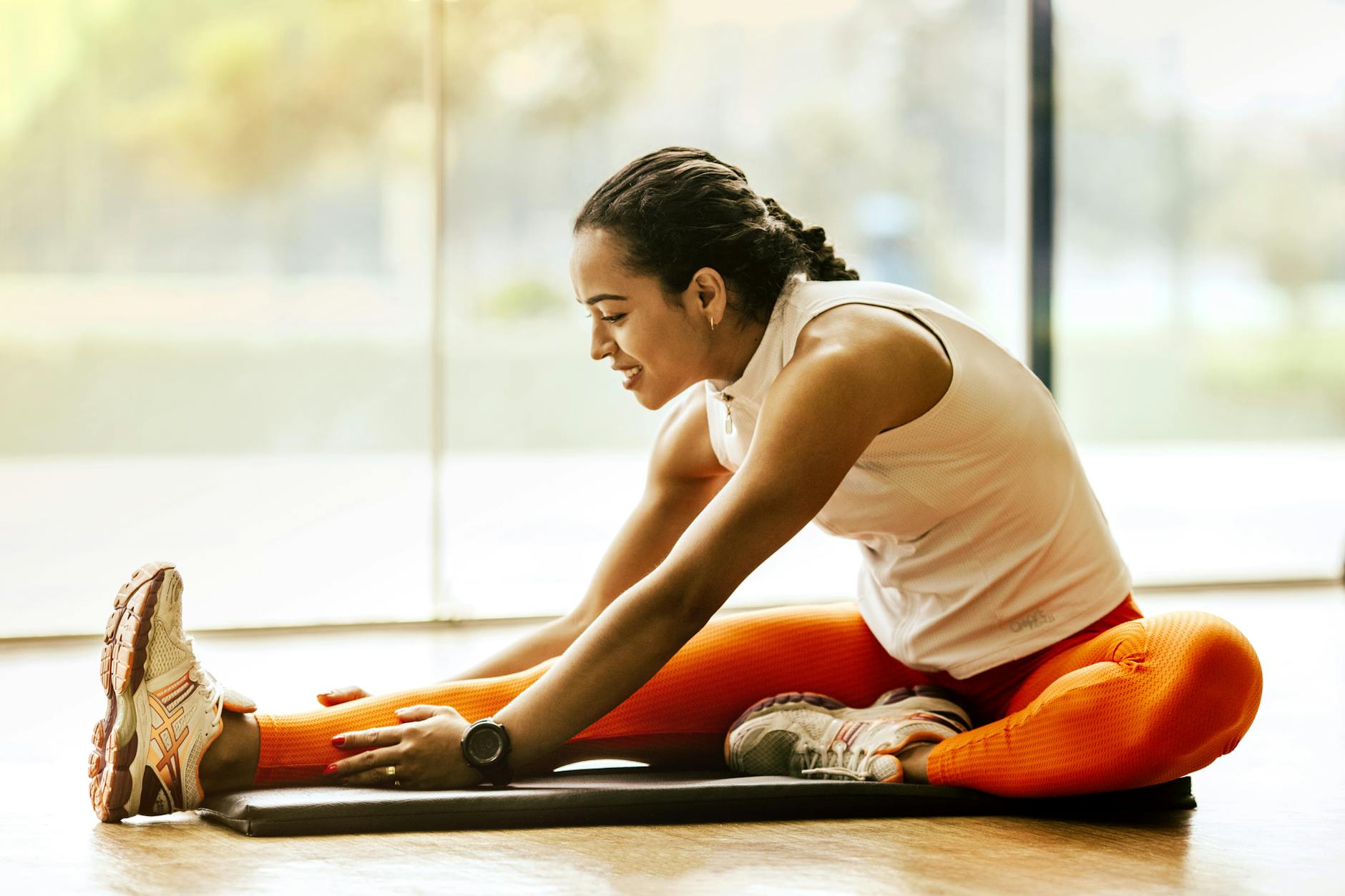
Do you sit up in bed in the morning and raise your arms over your head for that first stretch of the day? It’s instinctual, and there’s actually a term for it: Pandiculation. Humans, along with all vertebrate animals, tend to automatically pandiculate when we wake up or when we’ve been stationary for a while. If you’ve ever seen a cat arch their back when they get up from a nap, you’ve witnessed the pandicular response. When we pandiculate, we’re contracting muscles that have been inactive. Pandiculation is an automatic response that prepares out bodies for movement.

So, in a way, we are wired to stretch.

We’ve all heard about stretching and how important it is. But do we know why? What is actually happening when we stretch?

Stretching causes our muscles to be lengthened. Yes, it’s that simple. Stretching is regulated by the “stretch reflex”. When a muscle is lengthened, it wants to contract again. Think of an elastic band, and how once you’ve pulled it tight, it’s working to go back to it’s original position. Stretching causes your stretch reflex to subside. Your muscle then begins to adapt to a new length without aggressively firing the contract reflex. So by gently, and consistently, stretching your muscles, you’re signaling to your body and your brain that this new lengthened version is “normal.” And this new normal allows you to move throughout larger ranges of motion for day to day life with reduced injury risk.

And there are numerous other benefits to a consistent stretching routine:

Improved Flexibility: Your muscles will have a full range of motion so you can continue doing all of the activities you need and love in your daily routine and it will be easier to incorporate new movements and activities into your life

Improved Balance: You will be at a lower risk of falls and able to perform more complex moves both when exercising, and in real life situations like trying to reach something on a high shelf, or being able to do that yoga pose without falling

Improved Mobility: You will continue to be able to function in the manner you want throughout your entire life, continuing with all your favorite activities

Independence: You won’t be reliant on canes, walkers, or other people as you age

Reduced pain: You’ll be able to move as you want, without feeling it in your back and joints. Strengthening muscles and joints can also reduce back and knee pain caused from arthritis

Preparation for more physical activities: You’ll be better prepared to take on a new activity like running, where a sprinter needs to be able to fully extend and rotate their hips in order to achieve maximum speed

Releases endorphins: Those feel-good hormones can act as a pain reliever and also cause feelings of euphoria

Improves circulation: Stretching helps with circulation by increasing blood flow to the stretched area, widening the blood vessels to allow more blood to flow through. The increase in blood flow means your muscles are getting more oxygen, and are getting rid of more waste products

Stress reduction: Stretching will lead to stimulation of your parasympathetic nervous system which is responsible for rest and digestion, as well as inducing feelings of calmness and relaxation

Better posture: Muscle tightness and tension can negatively impact your posture by putting your spine into positions that can put stress on your back, neck, and core

Reduced risk of injury: Stretched muscles can help reduce injuries by improving blood flow, flexibility, and range of motion

The benefits of stretching are something you might not notice immediately, but over time you will be reaping all of the benefits as well as improving your quality of life in later years. Of course, the opposite is true. You might not be noticing any negative effects of NOT stretching–until its too late.

There are 2 different types of stretching, each accomplishing a different objective.

Static Stretching is when you hold a single position for a period of time. It requires moving a muscle as far as it can go but not so far as to be painful, holding the stretch for 20 to 45 seconds and if desired, repeating 2-3 times. No bouncing. Static stretching is best used as part of your cool-down routine following a weight or cardio workout, when your muscles are warm, to assist in reducing risk of injury and soreness. Use it also alone as a maintenance program to take advantage of all the benefits of stretching.

Dynamic stretching is a controlled movement that prepares your muscles for performance and safety. During a dynamic stretch your body is in continuous movement, as opposed to holding a single position. As with static stretches, you can limit dynamic stretches to the body parts you plan to work on that day. Dynamic stretches prepare your body for a workout by increasing blood flow to the specific muscles and preparing your body for the workout movements by going through a series of movements. Dynamic stretching has been shown to improve performance during your workout, and therefore is most effective when used after a warmup and before a scheduled workout. In some cases–such as jumping jacks–your dynamic stretch can do double duty as your warmup. Gently warming up your muscles in this way could also make your workout more effective. A typical dynamic stretching series focused on 2 or 3 muscle groups may last as little as 3-4 minutes.

Both types of stretching are most effective when muscles are warmed up, which improves mobility, blood flow, and reduces stiffness and risk of injury. And stretching can be done outside of a workout as well. It doesn’t require much time, or space, and needs no equipment. There are many stretches you can do while sitting at your desk or in front of the tv. Even standing in line or sitting in your car (but keep your hands on the wheel and your eyes on the road!) And as with your regular workout, be conscious of your breathing so you aren’t holding your breath.

There are an unlimited number of stretches that you can do, but below are some common ones that you can try to get started. If you’re already on a schedule with a workout routine, I recommend incorporating muscle specific stretches before (dynamic) and after (static) your workouts. Then try adding in a full body static stretch workout on your rest days. If you’re not currently engaging in a regular cardio or strength routine, you should still be stretching, so choose some stretches from the list below to get started.

Static stretches: Hold each stretch for 30 seconds before switching sides, if applicable.

Neck stretch: This is a stretch you can do anywhere: Sitting, standing, even lying down. Simply tilt your head to the left, with your head still facing forward, until you feel a stretch. You can use your left hand to gently press your head to one side for a deeper stretch but no jerky movements and don’t press too hard. Keep your shoulders pressed down.

Chest Stretch: Stand up straight with your body aligned in a straight line. Interlock your fingers behind your back and gently pull open your chest, keeping your back straight and your shoulders down and squeezed toward each other. For a deeper stretch, you can gently pull your arms up behind you.

Shoulder Stretch: While standing or sitting, hold one arm straight out in front of you. Gently use the other arm to pull the arm across your body until you feel the stretch in your shoulder. Some people will hook the arm with their elbow (see illustration below).

Photo by Miriam Alonso on Pexels.com

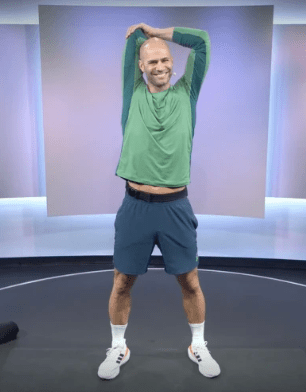
Triceps Stretch: In a standing position, raise both arms up straight. Then bend your left arm with your hand reaching behind your head, until you feel a slight stretch in your triceps. Place your right hand on your left elbow and gently push the elbow to get a greater stretch.
Biceps Stretch: In a standing position, raise your left arm out in front of you with your palm facing up. Use your right hand to gently pull your fingers down until you feel the stretch in your biceps.

Side Stretch: Stand tall and place your hands on your hips. Bend at your waist to the left until you feel the stretch. Be sure to continue facing forward and not twist your hips. Alternately, you can stretch your right hand over your head toward the left for a deeper stretch.

Abdominal Stretch: Lay flat on the floor on your stomach. Placing your hands flat at your sides, push your upper body away from the floor until you feel the stretch in your abdominals.

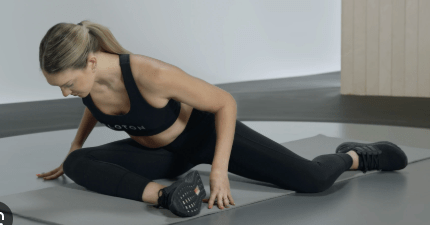
Hip Flexor Stretch: Sit on the floor with your legs in front of you. Bend your left leg at a 90 degree angle and move your right leg behind you in a bent position. Gently lean forward until you feel the stretch.
Hamstrings Stretch: Sit on the floor with your legs together and straight out in front of you. Gently lean forward until you feel the stretch in your hamstrings. If you can, you can hold place your hands under your knees or shins, or when you’re more flexible, hold onto your feet.

Quadriceps Stretch: Lie on the floor on your left side. Bend your right leg back so your foot is moving toward your bum. Reach back with your right hand and grasp your leg at the ankle or shin. Gently pull the foot toward your bum.

Calf Stretch: Stand facing a wall with your palms against the wall and your feet about 6 inches away from the wall. Step your left foot back, keeping your heel on the floor, so your left foot is straight and you right leg is bent, feeling the stretch in your left calf.

Dynamic Stretches:

Arm Circles (Works shoulders, neck, and upper back, and even a little chest, biceps and triceps): Stand straight and bring each arm straight out to the side. Rotate each arm in slow circles toward the front for 20 rotations and then reverse and rotate toward the back for 20 rotations.

Leg swings (works glutes, hip flexors, and hamstrings): Stand straight. Gently swing your left leg forward and backward for 20 repetitions. The swing the leg from side to side for another 20 repetitions.

Jumping Jacks (works shoulders, inner and outer thighs, calves and glutes): Stand straight with arms at sides. Simultaneously move your arms up and toward you head while jumping your legs apart, to form an “X.” Repeat 20 times.

Inchworm (works hamstrings, core, shoulders and chest): Stand straight with feet hip width apart and arms at sides. Slowly bend over and touch hands to floor, keeping legs as straight as possible. Walk hands forward until you reach a plank position. Reverse to starting. Repeat 20 times.
Maximizing Your Brain Power

Photo by Amel Uzunovic on Pexels.com

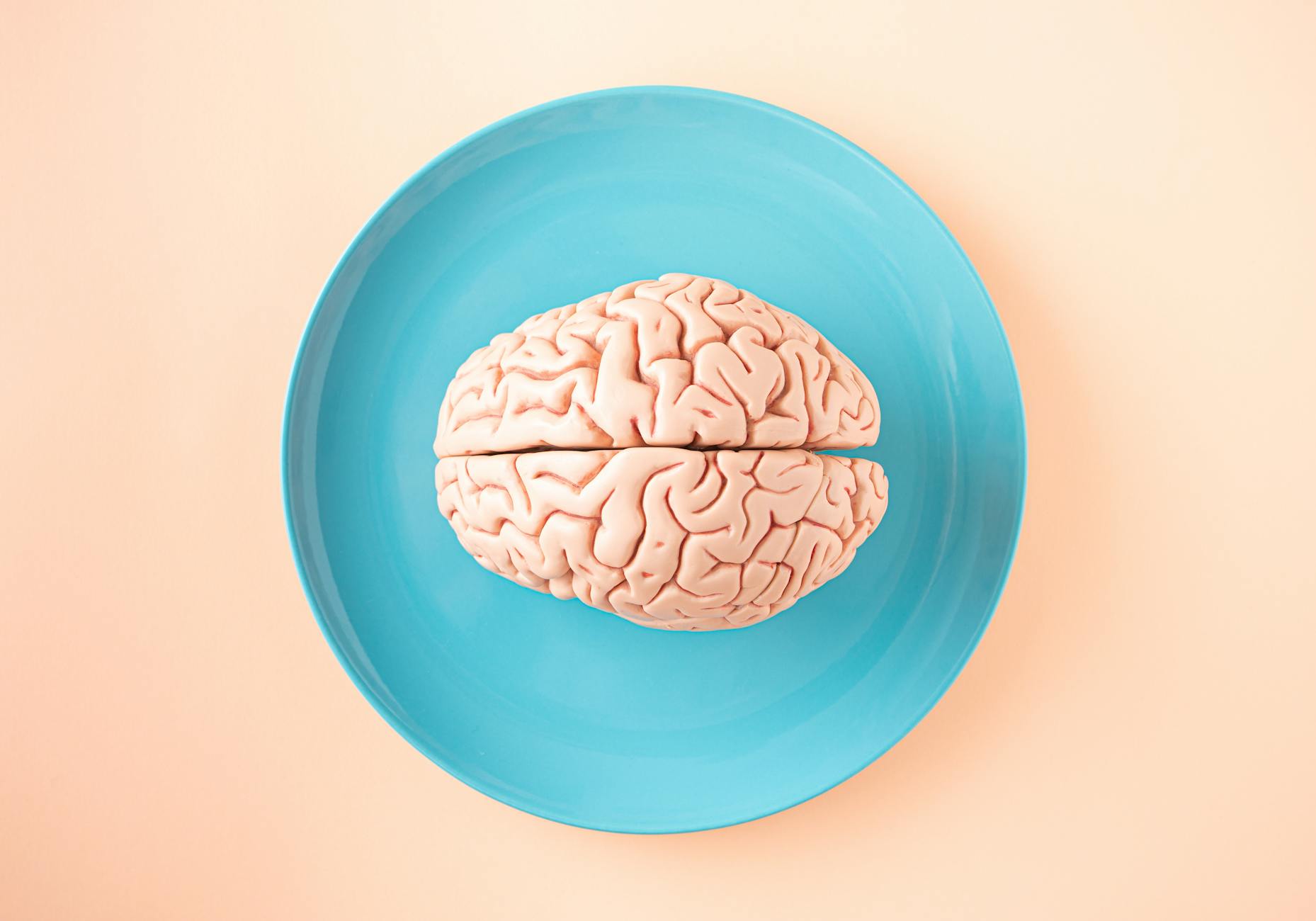
While you may have heard that we only use a very small percent of our brain–I’ve heard as low as 10%–turns out, that’s not true. Current thinking and studies suggest that most people actually use most of their brain. Imaging studies can see different areas of our brain being active during different functions or activities. While some portion of our brain is always active, by studying the brain during different types of activities, we can see that most of our brain is used in our daily lives. In fact, most of our brain is active during most of our daily activities.

Our brain is the most complex organ in our body. It weighs about 3 pounds and contains about 100 billion neurons that carry information to, and from, other parts of our body, at speeds of up to 250 miles per hour! The brain represents 2 percent of our body weight but uses 20 percent of our oxygen and calories. It is 73 percent water. The average brain generates 48 thoughts per minute. That’s almost one every second, and 70,000 thoughts per day!

Clearly, our brains are essential to our survival. Every single thing we will do today involves our brain: Motor function and coordination, taste, smell, sights and sounds, all of our thoughts and feelings, decision making and impulse control, functioning of all of our organs, both voluntary and involuntary, memories, and speech. So keeping our brains healthy should be a top priority. Our memory and cognitive skills actually begin to decline as early as our late 20s, so it seems pretty obvious that we would want to start as soon as possible to keep our brains functioning at top capacity, for all the years that we’ll need them. In addition to being necessary for the daily functions of our life, and being able to maintain our social connections, we also want to continue to learn and experience new things. A well-functioning brain will ensure we can learn new things, and learning new things will help to keep our brains healthy, so each reinforces the other.

Before we talk about what keeps our brains healthy, let’s talk about some conditions that can develop from an unhealthy brain. There are many types of irregular brain conditions. We often think of memory diseases like dementia when we think of brain health. Dementia is a broad term meaning decline in memory, language and problem solving abilities. Alzheimers is a condition and is the most common cause of dementia. There are numerous other conditions that are the result of a brain disorder, including ALS, autism, brain tumors, epilepsy, Parkinson’s and strokes. Some of these are present from birth, and aren’t the result of any actions on our part, while others develop over our lifetime, and may be facilitated, or exacerbated by our lifestyle. Strokes, for example, are often seen in patients with high blood pressure, obesity, smoking, and poor diet. All of these risk factors can be partially, if not completely eliminated with some healthy choices.

Brain Health is dependent on three main factors: Diet, Exercise, and Lifestyle. The good news is that these elements are also good for your body and physical health, so while you’re working on your physical health, you’re also strengthening your brain. Let’s take a look at why each of these is helpful, and what specifically we can do to maximize our brain health.

Diet:

Healthy eating in general will reduce your chances of developing diabetes, heart disease and high blood pressure, conditions that are known to increase risk for dementia. In addition, staying hydrated is very important for our brains. Remember the note above: Our brains are 73 percent water. Being dehydrated by as little as 2 percent can impair our ability to perform tasks requiring attention, memory, and motor skills. In addition to healthful eating, and staying hydrated, the following dietary elements may be beneficial to brain health:

  • Vitamin E and Beta Carotene promote brain health. For vitamin E, look for Fruits and vegetables with dark skins, such as spinach, broccoli, and blueberries. Leafy greens are also rich in B vitamins, which play a role in brain health. Those rich in beta carotene include red peppers and sweet potatoes
  • Oily fish, which contains omega 3s can help prevent brain shrinkage and support cognitive function. Seek out salmon, mackerel, and tuna
  • Walnuts and pecans are rich in antioxidants, which promote brain health
  • Dark chocolate and coffee have been shown to improve memory and brain performance
  • Caffeine can help perk you up, promote energy, and improve your focus

While no clear link has been established between certain vitamins and memory, the benefits of vitamins in general are clear. Most experts also agree that getting your vitamins from food sources is always preferable to a vitamin supplement. Supplements are not strictly regulated in the US and don’t have to prove that they work. Studies suggest they probably don’t, so skip the over the counter brain and memory boosters.

Exercise:

Regular physical exercise has been shown to boost the size of the hippocampus, the area of the brain involved in verbal memory and learning. Physical activity can also lower risk of heart disease, high blood pressure, and diabetes, all of which increase the risk for dementia. You can further improve your physical, and brain health, by mixing up your fitness routines, incorporating endurance, strength and flexibility exercises. This will not only improve your physical health, but the variety also keeps your brain sharp. Exercise will also help you reduce stress, and sleep better, both of which will keep your brain, and memory, healthy.

Lifestyle:

Aside from diet and exercise, there are other things you can do–or not do–that will benefit your brain health. Start by cutting out cigarettes and excessive alcohol. Smoking is a major risk factor for both dementia, and strokes. It can cause brain swelling, which may contribute to cognitive decline. Alcohol can impair the effectiveness of neurotransmitters in the brain, and also destroy brain cells. Alcohol can also increase your risk of mental health problems, and dementia.

Avoid multitasking. The brain can’t learn or concentrate on two things at once, but it can quickly switch back and forth between tasks and thoughts, so it feels like you’re successfully multitasking. In reality, doing so decreases your attention span, ability to learn, short-term memory, and overall mental performance. So when possible, complete one task before beginning the next. And if you know you need a relatively large chunk of time, schedule the task when you know you have a good chance of not being interrupted.

Stress and depression can cause brain shrinkage, and are risk factors for dementia. So try to reduce stress. I know, easier said than done! Meditation and deep breathing have been found to not only reduce stress and depression, but also to improve memory and attention. Cultivate relationships with the people in your life who are positive and who make you feel better about yourself, and your life. Social contact can provide a sense of connection and purpose, and just the act of conversation forces your brain to use language and vocabulary skills, further sharpening your brain. Spiritual activities such as religion, meditation and practicing gratitude have similar benefits of purpose and support and offer the same benefits as your social interactions.

Other ways to reduce stress include volunteering, and getting outdoors. Helping other people, and getting in tune with nature, are calming, feel-good activities. And don’t be afraid to ask for help. Delegate tasks if you’re feeling overwhelmed. Whether at work, or at home, there is likely someone who is willing, and able, to help.

Lastly, to reduce stress, don’t forget the best medicine, laughter! Sources of laughter can be found everywhere, including your personal friendships, a YouTube video of silly animals, or a live or recorded comedy skit. Counseling can help many of us to reduce stress. It’s good to share feelings of anxiety with someone who is not only objective, but also trained in ways to help you cope. And always seek counseling if you feel your stress, sadness or depression, has gotten worse or is seriously affecting your life.

Get enough sleep. Lack of sleep can affect your mood, energy, focus, and overrall function. In addition, memories get cemented while you sleep, so getting your 7-9 hours will help you to recall those important facts when you need them.

If your goal is to keep your brain sharp, there are strategies to improve those odds. Games are a good way to challenge your brain, and keep those neurotransmitters firing. Try crosswords, puzzles, crafts, sodoku, playing cards, and books. Studies have shown that those who used brain training exercises decreased their risk of dementia by 29 percent. It doesn’t have to be a scientifically created program. Just challenge your brain in as many different ways as possible. We’ve all had days when we drive to work, and can’t remember the drive at all. That kind of programming is not creating the new pathways that are beneficial to our brains. So your brain training doesn’t have to be superchallenging. Just shake up your daily routine with small changes like taking a different route to work, making a brand new dish for dinner, or reaching out to a friend you haven’t spoken to in a while. It should go without saying, that screentime, and in particular, social media, do NOT challenge your brain. So limit the scrolling and pick up a book, or invite your besties or family for a game night.

Most people get worried about their memory as they age. A declining memory is definitely a reality of aging, and most times is not reason for concern. Forgetting someone’s name, or why you went into your bedroom, are normal, especially as we get older. Speak to a doctor if you, or a loved one, is unable to remember the purpose of objects–like what a hairbrush is used for, or if you’re getting lost while walking or driving in an area that should be familiar–or if its affecting your ability to complete daily chores, like taking longer to complete a task that involves multiple steps. If you realize your memory issues are normal, and not signaling a more serious condition, there are some ideas you can try to improve your ability to remember, particularly in a certain area like an upcoming test, or wanting to better remember people’s names when you meet them:

  • Use images to remember facts; our brains process images faster than words, and making it silly will make it easier to remember; example: To remember the last name Rosenfield, picture the person running through a large field surrounded by rose bushes
  • Use an acronym, like RoyGBiv (the famous acronym to remember the colors of the rainbow) or use a silly phrase: To remember multiple people you met at a party: Richard, David, Sally, John, Savannah: Red Dogs Seem Just Super
  • Say it out loud: If I say, I am putting my keys on the dresser, out loud, I’m more likely to remember that later when I’m looking for my keys; better yet, tell someone else
  • Write it down or draw a picture

Our brains are vital to all facets of our lives and keeping them functioning at peak capacity will ensure that we can live our best lives. There are many things you can do every day to improve your brain’s performance, and keep it running in top condition and for the most part, the best practices for your brain will also benefit the rest of your body, and will lead to a healthy, active life for all the years to come.

Wall Pilates: Cardio and Strength Training Benefits

Photo by Anna Shvets on Pexels.com

I’ve recently started a Wall Pilates workout. Although I’ve experimented in the past with many different types of workouts: strength, cardio, aerobics, walking, running, yoga, etc, I had never tried Pilates. I think I always viewed it as something requiring a lot of flexibility, and I’ve never been very flexible. But I’ve been seeing Wall Pilates workouts and testimonies a lot lately, and it intrigued me as something that seemed doable, and that could lead to results. One of the aspects that really appealed to me, was that it seemed to incorporate both strength training and cardio, so I was very interested to see if that really was the case.

Wall Pilates is a slightly different version of traditional Pilates, which was created by German physical trainer Joseph Pilates in the early 20th century. Pilates’ goals are core strength, stability, and flexibility, and focuses on breath, cervical alignment, rib stabilization, pelvic mobility, and abs. Wall Pilates has the same focus. Pilates is practiced worldwide and is practiced by over 12 million people.

I’m not someone who goes on an exercise plan and then abandons it after several weeks. I’ve been a faithful, consistent exerciser for over 25 years. It’s essential to my life and I always make time for it. The level and variety of my workouts has definitely changed over the years. Prior to having kids, I could have hour-long strength training workouts focused on a limited number of body parts, multiple days a week. Twenty years later, my workouts are shorter, and less intense. Sometimes I’ve focused more on cardio, and other times, more on strength training. And I do like to change things up. I think novelty makes things more interesting and experts agree, it’s good to have variety and also to challenge your body in new ways.

I’ve never had a gym membership but I’ve built up enough equipment in my basement to tackle most programs. It doesn’t really take much. You could probably create enough of a challenge, and have the ability to change things up, with three or four sets of dumbbells. I also have a yoga mat, some resistance bands and ankle weights. In the past I’ve used a weight bench, barbell and free weights, but that’s not part of my routine these days. And, of course, my most important piece of equipment is YouTube. Regardless of your fitness level, or the type of workout you’d like to try, there is a video out there to guide you.

So I was excited to try Wall Pilates. As a complete beginner, I knew I would need some help getting started, and, as with most exercise programs, there are many ways to help you take the leap. Wall Pilates is no exception. There are books, apps, gym classes, and videos. While many options require a paid membership, or subscription, lots of free options do exist. Although I have always been opposed to paying to exercise, I realized I had no idea where to start with my new Wall Pilates program, and decided to purchase an app, Yoga Go, which costs about $15 a month. I also used Rachel’s Fit Wall Pilates, a free program available on YouTube.

The Yoga Go option was designed specifically for me. I answered some questions when signing up as to my preferences for workout length, fitness goals, current fitness level, and comfort level with Pilates. And I could respond each day to how I felt about the workout. Responding that it was “easy,” would mean a slightly more difficult workout the next day. I really liked this feature. Rachel’s Fit Wall Pilates gave me the opportunity to dive right in with the Day One workout. Both options advertised a 28 day program, which I thought was a good amount of time to see if I liked the exercises, and if they yielded results. In my case I was looking for some toning in my abs, glutes and thighs, with some ability to get my heart pumping, and was also looking for some lower numbers on the scale.

Requirements were simple: A yoga mat and some clear wall space. You do need a decent amount of wall space as some moves are done with your back on the floor and feet on the wall, and others are done standing, with your back against the wall. I set up in my basement and needed to remove a couple of framed photos from the wall in order to leave space for full movement. Both Programs offer good video, with verbal instructions for moves, which is good, because most of the moves were not familiar to me. I found Rachels Fit Pilates to offer more down to earth explanations, enabling me to sometimes figure out a move just by listening. But I also viewed it on my laptop, which meant that if I needed to look at the visual, I could see better than the Yoga Go app which was on my phone. I often needed to pause both versions–but Yoga Go in particular–to allow time to move between positions and figure out the mechanics of the next movement. The Yoga Go phone app workout also required me to move the phone occasionally as the workout progressed, depending on whether I was doing a move standing up versus lying on the floor. That was a little cumbersome. Another feature of the Rachels workout that I really liked, was she often showed a basic version of the exercise, and then a more challenging version, so you could adjust the workout to fit your fitness level, or your energy level on that particular day.

Neither option offered broader advice, like how often should I workout, and when, and should I alter my diet? It’s possible that that information is available somewhere in the programs, but I was not able to locate it after a quick search, and it never came up during the actual workouts. I would have appreciated something like that. I’ve always been a firm believer in rest days, and my schedule does not really allow for a workout every day. I had the impression that the 28 day programs were every-day-for-28-days which surprised me. I continued to take off days while I worked through both programs. I did complete 28 days of both programs, but it did take me longer than 28 days to accomplish that.

I like that the workouts are short, most in the range of 15-20 minutes, which allowed me to double up on some days, doing both the Yoga Go and the Rachels. Or I sometimes added a walking workout to one or the other of the Wall Pilates workouts. I also added in an occasional upper body dumbbell workout, as I felt the Pilates didn’t emphasize this as much. Rachel’s Fit did incorporate one or two days of light upper body moves with weights, but Yoga Go never did. I did often feel sore the next day, particularly with more lower body workouts, and I was sometimes out of breath, more from the strain of the movements than from high energy movements. I did find some of the moves to be challenging, both in the mechanics, and in the sheer muscle and flexibility components. If you were just watching the video, it would look easy and not very challenging, but the completion of the moves was more strenuous than I expected.

I would definitely say that there is a strength component to Wall Pilates, which is most often done with only your body weight for resistance. If you think body weight alone can’t garner results, do a few pushups, and then let me know what you think! Pushups are generally considered to be one of the best full body strength builders out there. But I agree with most experts, who say that if you really want to build visible muscle, you will need to incorporate weight bearing exercises into your daily routine. But make no mistake, Wall Pilates is still a workout. I often struggled to complete the repetitions, and felt soreness the next day. You may not be entering a bodybuilding competition following completion of the program, but it WILL build muscle, so it can change how you look. .

Cardio? While Pilates is not high impact aerobics like running or jumping, it does still improve cardiovascular health by raising your heart rate and lung capacity. When your exercises pick up the pace, or require more stamina on your muscles, you are also working your heart. I frequently found myself breathing hard even though I was performing slow movements. In addition, the slow, fluid movements and focus on breathing and proper form, can be relaxing and lead to reduced stress, which is always a win.

Pilates and Wall Pilates are easy on joints and limit risk of injury. As with any strength exercise, proper form is important, so go to a class with an instructor, or watch a video to be sure you’re maximizing your benefits and minimizing injury risk. Pilates includes a lot of stretching, which can improve your flexibility and range of motion. If you’d like to test this theory, pay attention to your flexibility as you begin the program, and then check it at the end to see if there has been improvement. One simple way to do this is with the old standby of reaching to touch your toes. Pilates is a great workout to try if you’re a beginner exerciser, recovering from an injury or an older adult. Or if you simply prefer less intense workouts.

After completing both programs, I did see some toning. Nothing drastic, and no real weight loss, but to be fair, I did not alter my diet at all, which I’m sure would have resulted in more noticeable results. I think the most telling factor is that I’m going to continue working the program, albeit selectively. The Yoga Go program will continue to get more challenging as I rate each workout, and with Rachel’s Fit, now that I’ve completed the full 28 days, I can go back and choose which workouts to do, so if I want to focus more on abs, I can do that particular workout for a period of time. I do still hope to have continued results with toning and improvement in flexibility and balance, as these are functions that can be beneficial in performing all of our daily activities. And I’ll continue to add in other types of workouts, and try new things that come along, so I never get bored with exercise, which is such an important factor in my life.

The Touch Factor

Photo by August de Richelieu on Pexels.com

Do you look forward to the moment you see a good friend, and anticipate the hug that will follow, imagining the love and joy you’ll feel as your arms reach around her and squeeze? Or, is it the opposite? Anxiety as you anticipate that obligatory hug? Discomfort and unease and hoping it will be over as quickly as possible?

I need to make a distinction here. There is a legitimate phobia of being touched that is beyond just uncomfortability. That fear is called Haphephobia. It’s defined as extreme, irrational distress over being touched by anyone, and it is immobilizing for many people. It’s symptoms can include nausea, vomiting, heart palpitations, sweating, hyperventilating, hives, and panic attacks. That’s not the kind of unease being addressed here. What I’m talking about is slightly less debilitating, but still very real. These are the people who say “I’m just not a hugger.”

Of course we’re not just talking about hugging, but all aspects of physical touch. And there are many different levels of this love/hate relationship. There is the extreme toucher who will grab someone they are meeting for the first time and hold on like its a long lost best friend. You’ve probably seen a scene like this in a movie. A young man is meeting his girlfriend’s parents for the first time and is nervous about how he will be perceived. He offers a “nice to meet you Mr. Smith,” and Mr. Smith says, “oh, get over here and give me a hug!” and proceeds to grip him firmly and hold on for dear life. And then on the other end of the spectrum is the person who hangs back, giving a simple, small wave–at a safe distance of course.

So I wondered. How come some people like it and some people don’t?

This question brings up the usual response when discussing many human characteristics: Genes, or Environment? The evidence regarding touch seems to lean more heavily on the side of environment. Studies have shown that how much you touch as an adult is directly linked to the amount of physical touch you received in childhood. A 2012 study published in Comprehensive Psychology found that people raised by frequent huggers were more likely to be huggers in adulthood. And the opposite is also true. If you were raised with little physical touch, you are likely to exhibit the same traits with your children.

There might be differences for men, versus women. In another study, published in Communication Monographs, researchers found that, in women, affectionate behavior can be explained 45% by hereditary and 55% by environmental influences. For men, affectionate behavior instead seems to be solely influenced by environmental factors. The study examined adult twins, comparing identical twins, who share both the same environment and 100% of the same genes, with fraternal twins, who share the same environment, but only 50% of the same genes (the same as other siblings). If genetics didn’t play any role, we would expect that the scores of people in fraternal twin pairs would be just as similar as the scores of people in identical twin pairs, who are more alike genetically. But that was not the case. The identical twin pairs scored more similarly than the fraternal twin pairs – at least in the case of women – suggesting that there is, in fact, a genetic component to affectionate behavior.

Part of the reason for a discrepancy between men and women may be that women, overall, tend to be more affectionate, perhaps the result of evolutionary forces. Still, in both cases environmental factors appear to play a bigger role.

Of course there are cases where the opposite is true: Some children grow up feeling starved for touch and end up being very demonstrative with family and friends later in life. I think I fall slightly into this category. While I always felt loved as a child, hugs and kisses were not part of our normal day. I have definitely tried to be different with my kids, and in addition to saying “I love you” every day, I have tried to hug and kiss them more than I experienced as a kid.

And yet. . . I have two children, and one will take any opportunity to grab a hug while the other will usually opt out. Hmmm. Similar genes, same environment. So whatever the dominant results are, as with most things in life, the studies don’t always bear out in reality.

Aside from the obvious factor of growing up with a family that was not physically demonstrative, what are some other environmental factors that could negatively affect your feelings toward physical touch?

  • Past trauma
  • Postpartum disorder
  • Stress
  • Lack of trust
  • Media
  • Personal relationships
  • Negative body image

And aside from the “hugging” gene, what are some genetic possibilities that might affect a person’s predisposition to touch? Neurodiverse spectrum seems to top the list. This covers many conditions including, but not limited to autism, aspergers, and ADHD. OCD is another possibility for a dislike of physical touch.

There also appear to be cultural differences. In one study conducted in coffee shops in different countries, findings showed that Americans touched approximately twice during a single conversation, but in France and Puerto Rico, that number was over 100.

So is one tendency better than the other? The answer to that appears to be a resounding YES!

Lack of physical touch can lead to an underdeveloped vagus nerve, a bundle of nerves that runs from the spinal cord to the abdomen. Research shows this can decrease your ability to be intimate or compassionate and can lead to an underdeveloped oxytocin system. Signals to the vagus nerve recognize any form of touch and release oxytocin –sometimes called the love hormone, or cuddle hormone. A lack of this release can hinder your ability to form human bonds, and this effect can be long lasting. A 2014 study of Romanian orphans who were hardly touched in the orphanage, found that those orphans, who were later adopted, did not display the expected rise in oxytocin when sitting on their parents laps, such as you might see in children who had this experience from birth.

Here are some other ways in which lack of physical touch can be harmful:

  • Lack of intimacy or intimacy avoidance
  • Lack of bonding
  • Feelings of unhappiness and depression
  • Anxiety
  • Difficulty sleeping
  • Low relationship satisfaction

On the flip side, the benefits of physical touch are numerous:

  • Feelings of happiness and pleasure
  • Feelings of being loved
  • Reduced stress
  • Reduced heart rate and blood pressure
  • Lack of depression due to oxytocin and serotonin
  • Higher self confidence
  • Feelings of reassurance, empathy, compassion from another person
  • Better immunity: A 2015 study by Carnegie Mellon showed that people who were hugged experienced a 32% boost in immunity
  • Lower levels of inflammation, a cause of many chronic health problems

Clearly physical touch has a positive impact on both our mental, and physical lives. So what should you do if you don’t like to hug, but would like to attempt to get the benefits of increased physical touch? Ease into it with less invasive forms of affection. Samantha Hess, a “professional cuddler,” runs a company that teaches people how to enjoy a platonic touch and claims to have 78 different poses to meet each individual’s comfort level. Try massage, holding and petting animals, getting your hair or nails done. We tend to think of hugging, but the benefits of physical touch apply to all types: A fist bump, back slapping, high fives and a simple hand touch on an arm can all create the same benefits. And these benefits extend to both individuals. Sit close to loved ones, try a hug with those who are closest to you. maybe a pat on the shoulder or back. You could even try a new activity like a team sport or dancing.

Of course we always want to be sensitive to others who may not like to hug. If you aren’t sure how others feel, reach out for a less invasive fist bump, or skip the contact altogether.

And if you’re already prone to physical touch, continue to encourage that tendency by reaching out for loved ones who you know would welcome it. Instead of just at bedtime, grab that hug any time, or try a pat on the back which works for encouragement, recognition, or sympathy. Younger kids also love a “secret handshake.” Let’s face it, you can’t perform a secret handshake without feeling happy and connected.

I know I said I’ve tried to be demonstrative with my kids, but the truth is, I don’t really want to touch or be touched by strangers, and I hate the fake hug with the pat, pat on the back with as little “real” touch as possible. However, even with people I’m meeting for the first time, I do enjoy a good, firm handshake, or a fist bump. To me those reflect friendliness and respect, which are always welcome.

But if you’re someone for whom I feel affection, give me a great big bear hug any day. And yes, you can squeeze.

To Walk or To Run?

If you’re someone who has ever thought about ways to stay in shape, get physically fit, or lose weight, you have very likely considered walking or running as a possible form of exercise. You’re not wrong. Both running and walking provide great cardiovascular benefits. Both can bring weight loss, and reduced risk of cancer, high blood pressure and chronic disease. Both improve endurance, circulation, and can improve mood and reduce depression. But which is actually better? The answer is not the same for everyone. It depends on your lifestyle, your health, your current fitness level, and your goals. With running, you can burn more calories in less time, but also have a higher risk of injury, both acute and chronic. With walking, you need more time to burn the same amount of calories, but also greatly reduce your risk of injury and have the added benefit of making it more social by adding a walking partner. Here’s a guideline based on some possible goals you may have.

Choose Running If:

  • You want more cardivascular benefit
  • You want to burn more calories
  • You want to lose weight more quickly
  • You want to train for a running event, or other endurance event
  • You have less time for a workout
  • You already have a baseline level of fitness
  • You do not currently have any injuries or chronic conditions, particularly in your lower body

Choose Walking If:

  • You’re just beginning an exercise program
  • You want to avoid any possible injuries
  • You want to also be social while exercising
  • You are currently obese
  • You want something that is easy
  • You want something that requires no equipment or other costs

Some other things to keep in mind if you’re going to begin a running program:

  • Get clearance from your doctor, especially if you have any physical condition
  • Invest in a good pair of running shoes
  • Always stretch before and after running
  • Begin with a warmup; walking is easy
  • Start small: A good beginning running program is to alternate walking and running; walk for 4 minutes and run for 1 minute for a total of 20-30 minutes; do this for several weeks or until the 1 minute of running begins to feel easier. Then slowly increase the running time 1 minute at a time (3 minutes walking with 2 minutes running, etc) until you’re running for the full 30 minutes
  • Alternate days of rest with your running days

Some other things to keep in mind if you’re going to begin a walking program:

  • Wear supportive shoes: you don’t need to invest in an expensive pair of walking sneakers, but you should wear shoes that have a sufficient sole to support your feet
  • Walk at a brisk pace and then switch it up: add in intervals, alternating periods of fast pace walking with moderate pace
  • Add in some inclines (hills, or treadmill)
  • swing your arms or carry small hand weights or wear a weighted vest

For either activity, be safe. Stay hydrated by drinking water before, during, and after your workout. If running or walking outside, wear a reflective vest especially if approaching or during darkness, carry ID, your phone and a whistle, run or walk in a well-lit, heavily trafficked area, and no headphones. Lastly, whenever possible bring a buddy.

Most experts will tell you the best form of exercise is the one you’ll stick with, so if you’re still unsure about whether you should select walking or running, try them both and choose the one that gets you excited enough to put on those shoes and get yourself out there!

Proof That We Have Too Much Stuff

Recently, while driving, I noticed a new building going up just around the corner from my house. Hmmm, I thought: New restaurant? Liquor store? Obviously my thoughts drifted to the products that I would enjoy the most from a new neighbor. But closer scrutiny illuminated something else. A storage facility. I inwardly groaned. Not only did this not benefit me in any way, but it is also unattractive, and a reminder of the excesses we seem to maintain. We need more space to keep more stuff.

Yes, we Americans have a hard time parting with our stuff. It might be the fear that immediately after parting with an item we will have a desperate need for it. Or maybe guilt, because it was a special gift from someone we love. Or an item that holds a special memory from a departed loved one. I’m not talking about hoarding, which is a mental illness, and may lead to a clutter situation that can make a home unliveable. What effects more of us is just the compilation of extra things over a period of time. Things that clog our basements, attics, and closets.

I admit, I’m guilty too. I have a closet full of clothes, only about half of which I wear regularly. And shoes, well, let’s not go there. I have a basement full of things I might need someday, and 3 crates of Christmas decorations, even though I only pull out about a third of them as each December rolls around.

I’ve been making an effort to downsize my stuff. Facebook Marketplace, Salvation Army, trash, are all good ways to eliminate unneeded items. Lots of things like new, but that I know I will never use again. For me it is satisfying to remove clutter from the house. To take a walk into a room and see clean, empty space where there once was a pile of unused items.

I’ve tried to make a dent in new items coming into the house as well. Do I need a new air fryer, or popcorn maker? I’ve certainly survived this long without either. And at Christmas, the focus has been much more on experiences than objects. This past year, gifts included tickets for musicals for my mother and daughter, an experience for driving a race car for my son, and an airplane flying lesson for my boyfriend. All, I hope, will exist in their memories long after the new sweater, perfume, or tech gadget will.

If you need evidence that our current society owns too many “things,” look no further than the nearest storage facility. While I admit to extra clutter in my house, I have to wonder at who is filling their home with things and then still needs a storage unit for other stuff? What are they putting in there?

Here are some staggering statistics:

65% of storage facility renters have a garage, 47% have an attic, 33% have a basement

The storage business costs us 38 billion dollars annually

Between 2015 and 2020, the number of storage facilities in the US increased 584%

Some usage makes sense: Businesses storing excess inventory, millennials moving into crowded, small, downtown spaces; Baby boomers downsizing after 40 years of collecting stuff. And then there’s just that discretionary income with which we want to have the newest gadget, appliance, or piece of furniture. While these reasons seem legitimate at first, a storage unit is “out of sight, out of mind.” Many people put things there as a temporary solution, and then largely forget about them. A year will pass and not only have they not had the need for any of those items, but they’ve also been paying a monthly fee for 12 months, perhaps unnecessarily. A better option might be to get rid of those items. And while we’re at it, get rid of that other “stuff” we’re not using in our homes.

Professional organizers can rattle off the benefits of decluttering.

  • If you’re paying for a storage facility, you’ll be saving money
  • Easily find what you’re looking for, resulting in less stress and time savings
  • Feeling in control, resulting in pride and self-esteem
  • Better relationships, if others in your home like things neat and tidy; also you will likely socialize more if you are comfortable inviting your friends over and also don’t have to fear unexpected drop-ins
  • Better health as decluttering leads to cleanliness, less dust, mold, mildew; a clutter free kitchen will lead to more food prep at home, which is often healthier, and studies show that people sleep better in a neat room with a tidy bed

That all sounds great, so how to get started? If you’ve been gathering and saving for many years, the task can feel overwhelming. The key is to start small. Really small. Start with a single drawer, or cabinet. I recently scheduled myself to clear out my “tool bin.” This is a large plastic container in my basement where I toss my hammer, nails, screwdrivers and other home repair items. As I sifted through I discovered many unnecessary items (How many screws do I actually need??), some repetitive items, and some items that I might need someday, but that are easy, and inexpensive to obtain, thus eliminating the need to keep one on hand. The result was a reduction of my bin by about half. I moved my items to a smaller bin, thereby freeing up some more free space in the basement. And yes, it felt good. So I’ll keep working at it. I’ve already scheduled my next little project for this coming weekend and while it’s still a little difficult to part with some things, I’m looking forward to the sense of accomplishment, and the look of that newly clean space.

Help Your Kids With an Early Start to Physical Fitness

Photo by Valeria Ushakova on Pexels.com

I’ve been practicing good physical fitness for about 30 years. That sounds like a long time, but I actually didn’t start to think about my health in this way until after I was married. I was relatively active as a youngster. I grew up next to a school and so had easy access to an area well suited for sports. Basketball, wiffle ball and kickball were daily occurrences while the weather cooperated.

But I didn’t really think about what was healthy, and as I entered my teen years, and socializing became a bigger part of my life, there were fewer basketball games and more card games, and I started to gain weight. I could sense my endurance diminishing in the rarer cases that I found myself needing to run, or participate in something active.

When I finally started to take my health more seriously, I had a lot of starts and stops. I did some research, set up a small gym for myself in the basement, and began teaching myself how to work out. It wasn’t easy. I know I slipped many times, telling myself I was too tired, or too busy. But I started to get into a routine. It was easier for me to work out in the evenings, so I got right to it when I got home at the end of my workday. I alternated cardio (back then we called it aerobics) workouts with strength training, spending 30-45 minutes a day. I started to see results. And I liked it. My arms were more defined, and I had abs! I slowly lost some weight and I felt great. I became addicted to the way I looked and felt.

My workouts have changed frequently over the years, sometimes more intense, sometimes less. Sometimes a greater focus on cardio, sometimes strength training, but I have always maintained a schedule and a routine. I might take a week off during the busy holiday season or when things are crazy at work, and I have changed my workouts to mornings now, but staying physically active is still a big, consistent part of my life.

One thing I’m certain of: It is much easier to stay in shape, than to get out of shape and have to get back in shape. So I frequently wonder, would things have been easier if I had started my journey to physical fitness earlier, as a child? And would the benefits have been greater?

Many of the ailments that plague adults, such as diabetes, high blood pressure, and obesity, have their roots in early childhood. By starting an exercise routine early, these maladies can often be avoided. So it seems to make sense that teaching kids about physical fitness at an early age is a great idea.

Children are the recipients of the same physical benefits as adults when it comes to both cardio and strength training exercise:

  • Increased strength and endurance
  • Increased flexibility
  • Improved posture
  • Increase metabolism
  • Enhanced motor skills

In addition, there are numerous non-physical benefits that can be particularly helpful to children:

  • Psychological well-being
  • Improved sleep
  • Setting, and working toward goals
  • Improved self-esteem

So how can you, as a parent, get your kids on the right path? Kids naturally love to move and play, so encourage this whenever possible. If their screen time seems to be higher than usual on a particular day, head outside for a game of tag or hide and seek. If the weather is preventing you from going outside and you’re looking for some indoor inspiration, check out kids workouts on YouTube. With your smart tv you can display the workout on a big screen and the kids will feel like they’re attending a fun class. Here are some more suggestions to help you get started and stay on track.

  • Make physical activity part of your daily routine, from the time kids can walk
  • Engage in lots of active play time both indoors and outdoors
  • Try lots of new activities and make it fun
  • Let them know about the benefits of staying active and how they’re keeping their bodies healthy
  • Make it part of a daily routine much like eating, brushing teeth, and sleeping
  • Exercise with them and emphasize benefits like improved strength and endurance

As they get older, you can make physical activity more structured: Okay we’re going to work out now so our bodies stay strong and healthy! Kids as young as 6 or 7 can understand a routine and also benefit from more structured routines, like strength training. If you’re not sure how to start with something like this, find an online resource to be sure you’re doing it safely. In particular always:

  • Consult with a doctor before beginning a strength training routine, especially if any medical conditions exist
  • Warm up and stretch before exercising
  • Use proper form
  • Stay hydrated
  • Be sure to take days off between strength training workouts
  • Don’t forget to breathe!

No matter the age of your kids, you can still institute some healthier habits. If they’re a little older you may need to start slowly with small changes, or exploit an activity you know they already enjoy by offering to take them to the skate park or basketball court. Like most behaviors, a good role model is the best teacher, so let them see you being active and exercising even on days when you can’t convince them to join you. By building these good habits early, you’re helping them to be healthy and preventing undesired medical conditions like obesity, diabetes and high blood pressure. In addition you will likely see their confidence and self-esteem improve as they see the benefits of regular exercise. So what are you waiting for? Go grab your kids and get active!

40 New Things to Try Today

Photo by Pavel Danilyuk on Pexels.com
Photo by Anand Dandekar on Pexels.com
Photo by Susn Dybvik on Pexels.com

These days, I have to stop and think about my age. Usually I’m shocked when I remember the actual number. Hint: I didn’t have a cell phone until I was in my thirties. As I think about getting older, my mind starts to wander to limitations and missed opportunities. At this point in my life I have to acknowledge that there are some things I will never do. Maybe I don’t have the time, or the money, or I’m not physically capable. It could be that in addition to getting older I have also gotten more fearful. Whatever the reason, I will never play tennis professionally, take several months to travel around the world, or sing in front of a large audience. Okay, that last one has nothing to do with age.

But there are many things I can still do. And even many things that I haven’t tried before. The same is true for you, regardless of your age. Studies show that trying new things is an important step in warding off alzheimers and other brain diseases, by helping to keep your brain sharp. Cognitive ability, physical activity, and social engagement have positive effects on memory and thinking ability as we age. In addition, people who engage in a variety of experiences retain positive emotions and minimize negative ones. Mini adventures can also lead to other non physical benefits like improved self esteem and confidence, making new friends, and even stumbling across an undiscovered talent or passion.

While we can, and should, continue to plan for the big items on our bucket list, we can start today with the small stuff. The following ideas can be tried with little advance planning, minimal time, money, or physical training. Most combine at least 2 of the characteristics that will benefit you most: Cognitive, Physical, and Social interactions. I have grouped them into 4 different categories: Learn something new, Get Social, Get Out and Explore, Put Yourself Out There.

Learn Something New

The idea here is to reach a little. Try something you’ve never tried, or only minimally tried. If you’re typically into athletic activities, try cooking or photography. Many local colleges offer unique classes. Check their catalogs. At Bunker Hill Community College in Massachusetts, you can take a 3 hour, noncredit course in Craft Cocktails and Mixology for $119. And frequently you don’t need to find anything this formal. For almost anything you want to try, there’s an online video that can show you how. Many of these items make for a great fun activity with other people, so grab a friend and broaden your horizons! Here are some other ideas:

–Bake a cake from scratch

–Tackle a home improvement project

–Take a scuba diving lesson

–Learn to play chess

–Learn a magic trick

–Take a CPR class

–Try a new sport

–Get a pet you’ve never had before

–Research your family tree

Get Social

Many options here to get together. It’s great to do things with your best buddies, but don’t be afraid to try something that will force you to meet new people.

–Join a team or club: Book club, poker night, sports team, trivia night; if you can’t locate your ideal group, start one yourself (www.wikihow.com/start-a-successful-club)

–Volunteer for something you’re passionate about

–Host an event: Dinner party, theme party, game night, scavenger hunt, larping; check out mymysteryparty.com; better yet, invite someone new to the mix

–Take a class in something you’ve always found interesting

–Meetup.com: organizes adult gatherings for like minded individuals

–Plan a day trip and invite your favorite travel companions

–Play like a kid: lasertag, paintball, hopscotch, hide and seek, roller skating, flying a kite, have a water balloon fight; challenge your kids to a contest in jumproping, hula hoops, cartwheels

Get Out and Explore

Exploring is all about getting outside and discovering new things. You don’t have to go far. There are interesting buildings, trails, boutique shops, cafes, country stores, etc, in every town in America. Start with onlyinyourstate.com.

–Go for a hike

–Try ziplining

–Find a great spot and watch the sunrise

–Attend a fair/farmers market/festival

–Go for a picnic

–Take the train/bus/ferry

–Attend an auction

–Try geocaching

–Go fishing

–Do some gardening

–Golf (full-on, mini-golf, driving range)

–Bird watching

–Paddle boarding

–Camping

–Look for covered bridges, waterfalls

–Explore a new culture: try their food, church, music, holidays, museums or historic sites

Put Yourself Out There

This is all about getting out of your comfort zone. Sure, you might feel awkward, silly, maybe even embarrassed. But it could also be a blast, and you’ll be so proud of yourself just for trying!

–Make a You Tube/Tik Tok Video

–Audition for a game show (go to a show’s website or check castingcallhub.com/tryout/game-show/

–Switch up your regular routine: If you’re a rock n roll girl, check out some live country music and line dancing; Go to the theatre to experience an unlikely movie selection; get a new hairdo, outfit, tattoo, piercing

–Try something that scares you: Roller coasters, ghost tours, public speaking

–Do something kind for a stranger

–Identify someone you’re grateful for and then tell them why you’re so happy to have them in your life

–Surprise someone who might need some lifting up: balloons, baked goods, or just a surprise visit

–Share a new interest or talent with your friends: made your first quilt? wrote a poem? Show it off with pride.

I hope this list has inspired you to try something new! You probably thought of some or your own ideas while reading mine. I’d love to hear about them. Share your ideas, and your experiences with me!